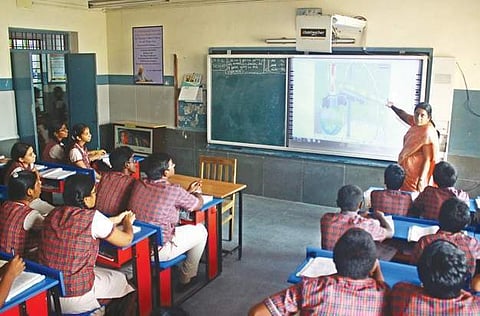

A nationwide survey of mathematical and linguistic proficiency by the National Council of Educational Research and Training has found massive deficiencies in basic skills among mid-primary and middle-school students. The survey, conducted in 2024, assessed 21,15,022 students across 74,229 schools in 36 states and Union territories. It found that among class 3 students, 50 percent could not classify basic geometric shapes, 50 percent could not perform simple monetary transactions, 45 percent were unable to arrange numbers up to 99 in ascending or descending order, and 42 percent could not perform addition or subtraction of two-digit numbers. At least 46 percent of class 6 students failed to understand simple multiplication, repeat additions and divisions.
This is disturbing and threatens the future of the science, technology, engineering and mathematics or STEM streams in India. It needs urgent corrective measures across the board. The numbers indicate a lack of basic arithmetic skills that anyone would require for everyday life. They project a looming vacuum in skilled human resources that could hinder the country’s progress at a time science and technology are poised for era-defining advances and stress is laid on indigenous development in every sphere. There is an urgent need to act on the survey’s recommendation of improving competencies in mathematics and science among school children, while emphasising the importance of gender-sensitive pedagogies, regional equity, and inclusive education.
Governments need to make mathematics learning an enjoyable experience in schools by using engaging ways to teach the basics and lay a strong foundation that would benefit the children as well as the country. Concurrently, the urban-rural divide should be bridged while identifying children with learning disabilities—especially dyscalculia (difficulty in understanding numbers, performing calculations, grasping mathematical concepts); dyslexia (problem with recognising alphabets, numbers, words and understanding text); and auditory processing disorder—and assisting them with specialised care.
Last year, the Union minister for youth affairs, labour, employment and sports, Mansukh Mandaviya, admitted to India staring at a huge shortage of skilled manpower. The crucial role of basic mathematical skills among children in raising an adequate technological manpower for the future should not be lost on anyone. Parents, teachers and counsellors—alongside the government machinery—must get involved in a nationwide exercise now, rather than regret later.