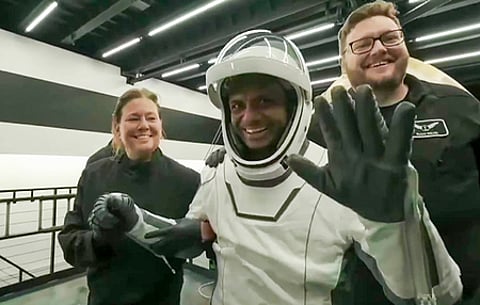

At 3.02 pm on Tuesday, Group Captain Shubhanshu Shukla (call name Shux) and his three crewmates’ space mission ended with the textbook splashdown of their return capsule in the Pacific Ocean off California. The Axiom 4 mission, which entailed 18 days of experiments and observations aboard the International Space Station (ISS), created history for the Indian space programme. Shux became the second Indian in space after Squadron Leader Rakesh Sharma’s April 1984 sortie to the Soviet Salyut 7 space station.
The 41 years between the two have witnessed significant progress in space technology. Therefore, a comparison between Sharma’s eight-day venture then and Shux’s 18-day mission now would be unfair. Besides, while the former mission was more of a diplomatic endeavour between India and the then USSR as a result of Cold War coddling; the Ax 4 mission was a commercial, public-private venture involving collaboration between Nasa, Indian Space Research Organisation and European Space Agency on one side, and Axiom Space and SpaceX on the other.
The experiments conducted four decades apart by both Sharma and Shux will be immensely relevant for India’s own maiden manned space mission, Gaganyaan, in 2027. Sharma was part of a crew that conducted 43 experiments including a pioneering study of the impact of yoga on the human body in microgravity; other biomedical studies assessing the effect of weightlessness on the body; remote sensing studies that later helped Indian satellites map natural resources; and material science studies. Communication with Earth—as crucial then as it’s now—saw Prime Minister Indira Gandhi asking Sharma how India looked from space, to which the air force officer famously replied, “Saare jahaan se achchha.”
Shux conducted seven experiments as part of the Ax-4 crew, which included growth and radiation response of edible algae; muscle regeneration with supplement treatment in zero-gravity; microgravity growth of methi and moong seeds; resilience and ageing patterns of tardigrades (microscopic creatures called ‘water bears’); cognitive testing with in-flight displays; comparative growth of proteins in cyanobacteria in microgravity; and the impact of microgravity on crop seed physiology. In his last words to the nation before leaving the ISS, Shux echoed Sharma with confidence and pride that India looks better than all other lands even today. The ambitious missions ahead will provide India ample opportunities to prove it in space as well.