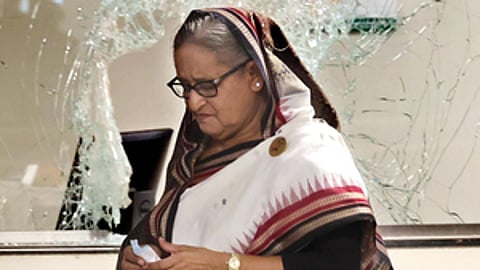

The death sentence handed to former Bangladeshi Prime Minister Sheikh Hasina may carry the weight of legal procedure, but it also carries the unmistakable smell of political vendetta. The interim government led by Mohammed Yunus termed the verdict “historic” and “profound”, while urging calm. Yet the very insistence on restraint amid an uneasy political clime reveals the depth of the fault lines running through Bangladesh.
Hasina was found guilty on three counts—incitement, ordering killings, and failing to prevent atrocities during last year’s student-led uprising. The tribunal delivered the stark punishment of the death sentence on two counts and imprisonment until natural death on the third. For a country traumatised by 2024’s turmoil, such choices are incendiary. After the uprising and subsequent crackdown, UN human-rights investigators estimated about 1,400 deaths, documenting several cases of point-blank shootings, deliberate maiming, and arbitrary arrest. Audio recordings verified independently also painted a grim picture of the state’s excesses.
Yet the ruling comes with a troubling context. Bangladesh today is governed by an interim arrangement whose legitimacy derives from crisis, not from the people’s mandate. The country has not stabilised under Yunus’s stewardship. Dhaka’s streets—filled with protesters and burning buses in the days before the verdict—testify to a nation drifting further from a much-needed equilibrium. But the rule of law and political stability cannot be rebuilt atop a foundation of retribution.
Make no mistake: Hasina, for her part, must own her mistakes—the failure to stop excessive force, the erosion of democratic institutions, and intolerance of dissent under her watch. But it is extreme to equate political accountability with execution. Justice should illuminate a path forward, not deepen the descent into instability.
For India, the moment demands sobriety. New Delhi must brace for a difficult phase in bilateral ties, especially as political uncertainty in Dhaka intensifies ahead of an election that may not see the participation of Hasina’s Awami League. But it must also heed the larger reality that Bangladesh is not merely its government—it is also its people, its shared culture, its intertwined economic future, and its security concerns. To lose sight of that would be to imperil one of the subcontinent’s most vital relationships.
For itself, Bangladesh has to decide whether this verdict marks the beginning of a reckoning or the continuation of vengeful politics. That choice will shape the region for years to come.
