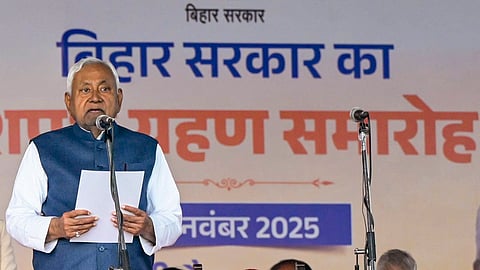

Eighteen years at the helm should give any leader clarity about what his state truly needs. Nitish Kumar returns as Bihar’s chief minister for the tenth time with that advantage—he knows better than anyone why Bihar has struggled to rise even as the rest of India races ahead. Yet knowledge alone is no longer enough. Bihar’s fundamental challenge is not growth itself—its GSDP regularly posts healthy numbers—but the quality and depth of that growth. A per capita income that is roughly one-third of the national average captures the structural imbalance. A state with abundant labour and a young demographic continues to operate like a low-income, low-productivity economy. Three-quarters of households remain tied to agriculture that generates barely a quarter of output. Services dominate but are concentrated in low-value, low-wage activity. Manufacturing is chronically underdeveloped. This imbalance is at the heart of Bihar’s ‘laggard’ image.
The easy political instinct is to reach for cash transfers and quick welfarist wins. However, a state where 74 percent of revenues come from the Centre, and where 42 percent of receipts are swallowed by salaries, pensions and interest, simply cannot fund grand doles without starving investment. Bihar’s problem is not just the availability of money—it is the sliver of discretionary funds left each year for development, often squeezed further by populism. Promising ₹10,000 to women repeatedly may mobilise voters, but the expenditure needs to be budgeted for annually without slicing off allocations for job avenues, functioning schools, skilled labour or reliable electricity. Double-engine sarkar doesn’t mean perpetual dependence on Delhi to bridge its deficits.
A new mindset is essential: one that treats development as a scientific, rational exercise rather than an electoral offering. That means modernising agriculture through integrated agro-industrial clusters—not merely celebrating makhana, but using it as a symbol of value-addition and export-oriented processing. It means attracting private investment by fixing policing, digitising governance, and insulating projects from corruption. It requires linking migration remittances to local enterprise, modernising skilling, and building an urban–industrial ecosystem capable of harvesting Bihar’s demographic dividend.
Nitish Kumar has the political authority, experience and mandate to begin this shift. His test is whether he can move Bihar from a culture of ad hoc measures to a long-term, execution-focused economic strategy. That will decide whether Bihar finally converges with the rest of India.