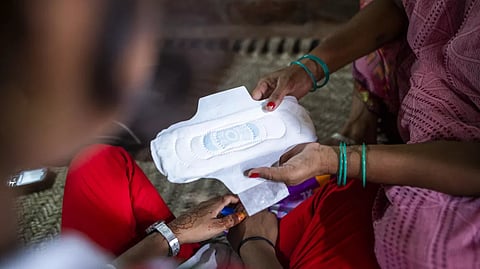

The Supreme Court judgement on the right to menstrual hygiene as an integral part of the constitutional right to life and dignity provides a long-desired direction towards destigmatising an essential bodily function and ensuring basic care. While observing that the lack of basic facilities and the stigma around menstruation directly affect girls’ health, education and privacy, the bench of Justices J B Pardiwala and R Mahadevan directed all states and Union territories to ensure within three months that every school has gender-segregated toilets, and biodegradable or reusable sanitary pads are provided for free to adolescent girls along with safe disposal facilities. The court also asked the governments to incorporate gender-responsive curriculums in schools and train the staff in assisting menstruating pupils.
The apex court’s judgement and directions expose the socio-cultural and religious taboos perpetuated by patriarchal norms. Period shame is every girl’s burden. The event of puberty, a milestone in human physiological evolution, is celebrated in many Indian traditions. But period ostracisation is so deeply prevalent in many sections that the victims of such misinformed belief and gender aggression are eventually socialised to become its carriers. The troubling apportioning of ‘shame’ continues through generations. For girls born into economically weaker families, sanitary pads are a luxury. Government schools, an ideal place to clear the misconceptions for both girls and boys, ignore this duty. To aggravate the insensitive attitude, their administrators often force hapless teenage girls to explain clothes stains as period blood, stripping them of dignity.
By one estimate, around 2.3 crore girls drop out of school annually on account of lack of adequate toilets and menstrual provisions. The launch of the Union health ministry’s Menstrual Hygiene Scheme in 2011 was a landmark attempt to destigmatise menstruation by giving girls aged 10 to 19 subsidised pads and menstrual education. But it left out the adolescent girls who are out of school. The right to education is as fundamental a right as the right to live with dignity.
With the Supreme Court spelling out the nuances of the constitutional right of young girls in detail, it’s time to fill the gaps. For that, government and private schools have to act in a timebound manner. And all three tiers of government have to ensure that awareness of the right as well as the health basics reach all sections of India—in every generation.
