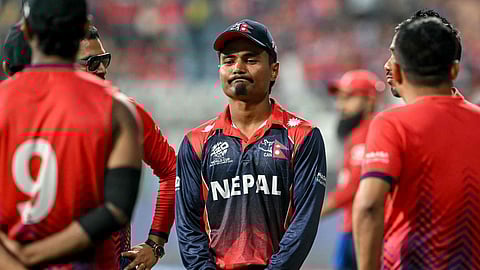

Nepal needed just 10 runs off the last six balls to record a fairytale victory over England on Sunday. For any other Test-playing nation, this would likely have been a leisurely walk in the park. But for an associate team that has just started to find a footing among the big boys of international cricket, it was a herculean task. The fine line dividing professionals from semi-professionals in elite sports was the deciding factor as Nepal fell short by four runs. On the first day of the T20 World Cup, the Netherlands and the US threatened to upset two of the big teams in world cricket—India and Pakistan. So it’s safe to say that two of the first three days of the event belonged to associate nations.
However, the results showed the associate nations’ inability to finish games, which in turn can be attributed to their lack of game time. Though the sport is slowly expanding to enter new territories in Europe (Italy) and Africa (Namibia), when it comes to funding and support, the International Cricket Council can do a lot more. According to the revenue sharing model set for 2024-27, India get 38.5 percent, with England, Australia and Pakistan next on the list in that order. All associate members put together get just 11 percent, compared to 89 percent for the dozen full members
It is not about funds alone. When it comes to match distribution, commercial interest overshadows everything else. For instance, Nepal have never played England in a T20I before. The US have played only once against India, at the last World Cup. Apart from Namibia, the Netherlands, Scotland and the UAE, none of the others have had bilateral T20I series against India, Australia, England, New Zealand, Pakistan or South Africa. Scotland and the UAE have played only four T20Is each, the Netherlands two and Namibia one.
For cricket to grow, newer playing nations need regular chances to compete and understand the nuances of the game. It is evident that the gap between the associate nations and Test-playing ones is slowly closing. With a little more care and planning, they can threaten the hegemony of the current elites. The ICC must understand that for cricket to be a global sport, this is exactly what is required.