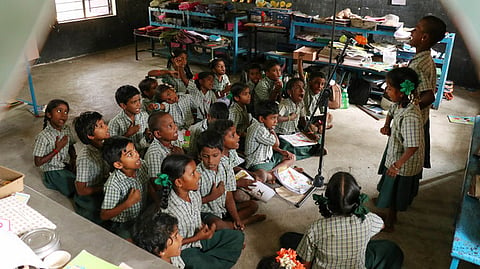

From 2026-27, the Karnataka government plans to phase out a three-decade-old learning programme designed to build foundational language and arithmetic skills for Classes I to III in 16,762 Kannada- and Urdu-medium government schools. The move has drawn opposition from the Kannada Development Authority (KDA), which has appealed to the minister for school education and literacy to continue the programme, citing its proven benefits.
Nali Kali (Learning with Fun), initially supported by Unicef, began in 1995-96 in Heggadadevankote in Mysuru district as a teaching-learning method aimed at providing primary schoolchildren an enjoyable and stress-free classroom experience. Recognising the value of the methodology, the state government introduced it in 2008-09 in 13,691 lower primary government schools with enrolment below 30 students, bringing it under the Sarva Shiksha Abhiyan. The following year, Nali Kali was introduced for Classes I and II in all government Kannada-medium schools and extended to Class III from 2010- 11. The World Bank and private organisations such as the Azim Premji Foundation supported the programme, while the state funded learning materials through the Vidya Vikas scheme.
While underlining the promise of Nali Kali, a recent KDA report based on a survey of 60 government primary schools flagged concerns about implementation. It found that teaching quality had suffered as newer teachers were not as well trained in the methodology as their retired predecessors. Larger class sizes affected classroom effectiveness, and teachers were increasingly burdened with non-academic duties such as election work, surveys and mid-day meal data management. The report also observed that students schooled under the Nali Kali model often found it difficult to adjust abruptly to a different system in Class IV. As a result, many parents are opting to move their children to far more expensive private schools.
This appears to be a classic case of a well-designed educational initiative weakened by inconsistent government application rather than inherent flaws in the concept. A strong foundational education is critical to a child’s holistic development. It shapes long-term academic, social and professional trajectories by building essential cognitive, emotional and literacy skills during the most crucial years of brain development. When implemented effectively, such a model nurtures resilience, curiosity and critical thinking—the bedrock of lifelong learning. Karnataka can ill afford to abandon a foundational programme without first fixing what went wrong in its execution. The focus must remain firmly on strengthening, not diluting, early learning.
