
Tamil Nadu needs more tax revenues to fund pension scheme
In a politically sensitive pre-election move, the DMK government has announced the Tamil Nadu Assured Pension Scheme (TAPS), covering nearly 6.25 lakh state government employees. Ever since the Contributory Pension Scheme (CPS) replaced the Old Pension Scheme (OPS) in 2004, employees have agitated for a rollback, arguing that CPS removed the certainty of an assured pension for those who joined service after 2003.
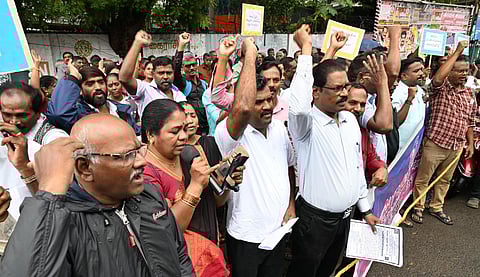
Chief Minister M K Stalin has taken a call that successive governments avoided for over two decades, deterred by the long-term fiscal burden. The announcement came days before an indefinite strike by government employees demanding restoration of OPS—a promise the DMK itself made in 2021. By introducing TAPS, the government has opted for a middle path. Structured as a hybrid of OPS and the Centre’s Unified Pension Scheme (UPS) launched in 2025, TAPS guarantees a pension of at least 50 per cent of the last-drawn salary, while requiring employees to contribute 10 per cent of basic pay and dearness allowance, as under UPS.
The compromise, however, carries a significant price tag. The scheme will require a one-time outlay of about Rs 13,000 crore and annual contributions of roughly Rs 11,000 crore, a liability that will grow over time. The opposition has dismissed the move as an election gimmick, pointing to Tamil Nadu’s debt-to-GSDP ratio, now above 26 per cent. The government has countered by arguing that its borrowings remain within the limits set by the 15th Finance Commission, while also accusing the Centre of steadily encroaching on states’ fiscal autonomy. It has cited the state’s robust GSDP growth of 11.19 per cent—the highest in the country—to argue that borrowing has been deployed to sustain economic growth.
Significantly, the government has set January 1, 2027 as the implementation date, allowing time to manage the fiscal impact. While employee unions have welcomed TAPS, they have demanded an earlier rollout. The government may be able to persuade them on timing. But honouring the promise will ultimately depend on strengthening the state’s revenue position—by plugging tax leakages, widening the base and improving collections, particularly in sectors such as mining. That fiscal discipline will be indispensable, provided the DMK returns to power.