
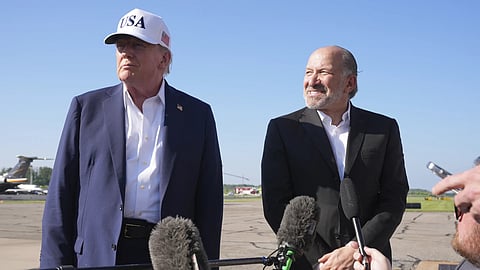
Trump pushes, India must respond with strategic autonomy
US President Donald Trump is pushing India, and not subtly. Tariff threats, public irritation over India’s Russian oil purchases, and backing for a sanctions bill targeting third countries all point to a familiar Trump doctrine: pressure first, partnership later. For India, this moment demands clarity, not accommodation or ambiguity. The proposed legislation authorising 500 percent tariffs and secondary sanctions on countries importing Russian energy is economic coercion, plain and simple. If implemented, it would directly undermine India’s energy security and penalise it for acting in its national interest. No responsible government can allow affordable energy for 1.4 billion people to become collateral damage in Washington’s domestic politics.
The pressure is not merely economic; the rhetoric is just as troubling. US secretary of commerce Howard Lutnick’s claim that a trade deal collapsed because Prime Minister Narendra Modi did not personally call Trump reduces diplomacy and negotiation to ego management. The external affairs ministry has dismissed the claim. Still, the signal from Washington is unmistakable: obedience is expected. India should not negotiate from a position of deference. This is why strategic autonomy is no longer a slogan; it is a shield. India’s recent diplomatic choreography is telling. External affairs minister S Jaishankar began 2026 in Europe, with stops in Paris and Luxembourg, participation in the India-Weimar Triangle with France, Germany and Poland; and preparations for visits by the German Chancellor and French President, as well as an India-EU summit.
Amid the strains of the Russia-Ukraine war, fragmented supply chains and global economic uncertainty; India and Europe share common interests: resilient trade networks, diversified energy sources, and a cautious approach to unilateral sanctions that disrupt markets. European capitals, while not free of their own strategic pressures, approach India as a consequential partner rather than a variable to be disciplined. This does not signal a turning away from the US. India continues to value defence cooperation, Indo-Pacific coordination, and deep economic ties with Washington. But partnerships built on leverage and threat are structurally fragile. Strategic autonomy, as India understands it, is not neutrality or avoidance, but the capacity to choose, balance, and diversify relationships without external coercion. India’s expanding engagement with Europe, then, is less about hedging against America than asserting agency. If Washington’s pressure is intended to hasten compliance, New Delhi’s experience suggests the opposite. At this moment, strategic autonomy is India’s true leverage.