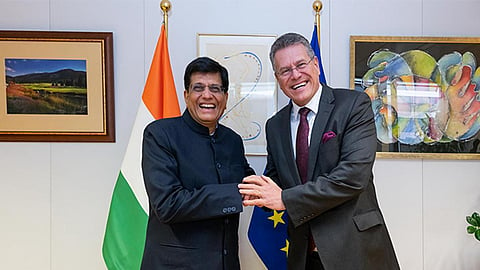

India's engagement with Europe is entering a consequential phase. A flurry of high-level visits, expanding trade ties and shared anxiety about global instability all point to a recognition that this partnership must move beyond symbolism and become a pillar of economic and strategic resilience.
Trade remains the anchor. The European Union is India’s largest trading partner in goods, absorbing roughly 17 percent of Indian exports. What is changing is the breadth of this relationship. The big European powers remain central, but countries such as Spain, Belgium and Poland are emerging as fast-growing destinations for Indian exports, broadening India’s commercial footprint across the 27-nation bloc. A long-delayed India-EU free trade agreement, if concluded, could further boost competitiveness in garments, pharmaceuticals and engineering goods at a time of demand uncertainty worldwide.
Yet, the relationship is no longer defined by trade alone. Europe’s turn towards strategic autonomy has made it a more serious geopolitical actor. This creates space for deeper cooperation with India in critical technologies, clean energy, digital governance, artificial intelligence and resilient supply chains. For Europe, India offers scale, growth and credibility in the Indo-Pacific. For India, Europe offers capital, technology and regulatory depth without the volatility of some other major powers.
The India-Middle East-Europe Economic Corridor (IMEC), launched at the 2023 G20 summit in New Delhi, gives this convergence a physical form. Built on the three pillars of transport, energy and digital connectivity, IMEC aims to integrate rail, port, power and fibre-optic networks across the continents. By cutting Asia-Europe transit times by about 40 percent and generating an estimated $5.4 billion in annual trade savings, the corridor, whose future is now obscured by regional conflicts, promises to offer a broader alternative to single-country initiatives such as China’s Belt and Road.
This alignment, however, is not without friction, most notably on Russia. Europe’s approach is shaped by proximity to war, sanctions and a hardening view of Moscow as a direct security threat. India’s stance is far from it. This divergence is real, but it need not be disqualifying. What matters is that India and Europe increasingly agree on strategic realism—that the broader objective is to prevent a fragmented global order dominated by coercion and closed blocs. As power shifts, India needs scale, technology and rules-based partners. Europe fits that bill. A decisive India-Europe partnership can shape a resilient, balanced global order.
