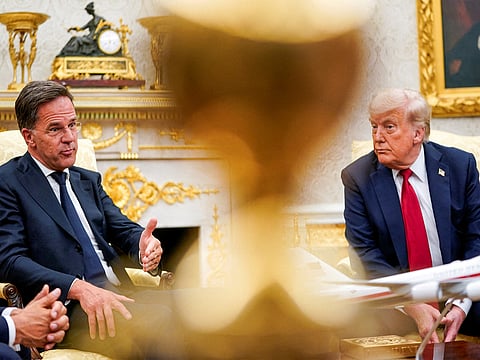

Donald Trump’s recent promise not to use force in trying to wrest Greenland offered Western capitals a brief, uneasy relief. But beneath the rhetoric lies a president intent on asserting dominance over the Arctic through coercion, signalling that allies can be compelled without direct confrontation. Trump’s shelving of the threatened 25 percent tariffs on eight European countries was less a retreat than a recalibration. After talks with Nato Secretary-General Mark Rutte in Davos, he floated a loose “framework” on Greenland and Arctic security, and suspended the tariffs due from February 1. The episode suggested neither victory nor defeat, but leverage tested and temporarily set aside—not surrendered.
The rationale begins with strategy. Greenland’s location carries immense weight in an increasingly militarised Arctic. Yet, Trump moves beyond strategic logic into entitlement, repeatedly calling Greenland “our territory” and firmly situating it within “our hemisphere”. The language recasts defence cooperation as a claim of possession. Familiar grievances follow: America’s wartime defence of Greenland, Denmark’s alleged ingratitude and the refrain that Washington bears an unfair Nato burden. Hints that allies might not be defended in return are more than bluster— they signal a worldview in which guarantees are conditional, respect is owed and loyalty carries a price.
Several impulses collide in Trump’s Greenland push. Arctic security concerns are real, particularly as Russia and China expand their reach. There is also Trump’s appetite for legacy—the allure of reshaping maps and leaving a historic imprint. Underpinning both is a fixation on respect: a resentment of perceived ingratitude for America’s role as the ultimate guarantor of Western security, and a willingness to extract costs from allies who take it for granted.
International law is clear. Danish sovereignty over Greenland was affirmed in 1933, and wartime arrangements conferred responsibility, not ownership. Yet, Trump has shown scant regard for precedent. Diplomacy has stalled, trade has been weaponised and Europe now faces an uneasy choice—retaliation risks fracture, restraint risks submission. When Trump says, “We’ll see what happens,” it is less a shrug than a test. Greenland, once peripheral, is now a litmus test for America’s alliances in a world where power increasingly trumps law.
