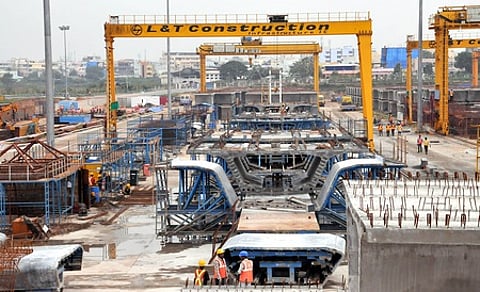

Telangana Chief Minister A Revanth Reddy’s recent meetings in Delhi with Railway Minister Ashwini Vaishnaw, Urban Development Minister Manohar Lal Khattar and Coal Minister G Kishan Reddy finally broke the deadlock between the Centre and the state over funding the Hyderabad Metro Rail project. The project’s first phase, executed by L&T in what was the world’s largest public-private partnership, ran into trouble post 2014 when the then state government insisted on route realignment. Execution was stuck for years and the costs rose from the original estimate of ₹15,000 crore to ₹22,000 crore, pushing the operator into losses running up to ₹400 crore a year.
As a result, L&T refused to be a part of the second-phase expansion. Following talks with the Centre and the operator, Revanth’s government agreed to take over the project, but then ran into trouble when the Indian Railway Finance Corporation’s promised loan did not materialise. It is in this context that a political war of words erupted between the Centre and the state. Instead, the two governments should have collaborated right from the start to ensure smooth operation and seamless expansion of such a vital project. Now, whatever the state had negotiated stands cancelled. SBI Capital Markets has been appointed to re-evaluate the first phase and chalk out a roadmap for the second.
The principal question is whether the state will have to bear the entire financial burden of the takeover. It has already prepared itself for the possibility and sought a loan from the IRFC. But as per the agreement, the second phase will be a joint venture between the Centre and the state. The plan is to add 122 km of lines to the existing 69 km. It would be ideal if the entire project, comprising the completed first phase and the planned second, are jointly operated by the Centre and the state through a special purpose vehicle.
In other words, it would be preferable if the Centre chipped in for acquiring the first phase, too. Whatever the consultant’s final recommendation, one thing this entire saga of the Hyderabad metro proves is that public-private partnership for a project of this scale and kind seldom succeeds in the Indian context. Another valuable lesson is to keep costs in check by avoiding delays and changes to the plans midway.
