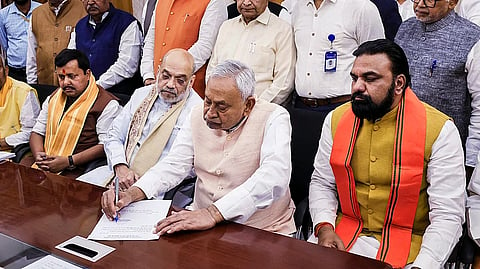

Nitish Kumar’s move from the Bihar chief minister’s office to the Rajya Sabha marks an unusual transition in Indian politics—a powerful regional leader stepping away from state power while remaining within the formal political arena. After nearly two decades in and out of office, and 10 stints as chief minister across shifting alliances, the shift signals the closing of a long chapter in Bihar’s governance.
The timing suggests careful choreography. Nitish remained in office through the election cycle, returned as chief minister and steered the state budget before initiating the move to Parliament. His message on X emphasising that the decision was voluntary appears designed to reassure supporters and pre-empt speculation that the move was forced or orchestrated by allies, particularly the BJP. At a time when questions about his health have circulated in political circles, the transition allows him to step aside without the optics of being displaced.
Yet the development inevitably raises questions about succession and the future balance of power in Bihar. For the BJP, which has long been the junior partner in the state despite its growing electoral strength, the moment presents an opportunity it has waited years for—to head the government in a politically pivotal state. Whether it chooses to assert that claim immediately or maintain the alliance equilibrium will be closely watched. For the Janata Dal (United), the shift carries deeper implications. The party’s political relevance has long been intertwined with Nitish Kumar’s personal authority and administrative image. Without him at the helm in Patna, it will have to navigate a future in which it is no longer the unquestioned centre of the alliance.
Nitish Kumar’s tenure shaped Bihar’s politics after the era of Lalu Prasad Yadav. His governance model—often summarised as ‘sushasan’—emphasised administrative stability, welfare measures and incremental development in a state long associated with political turbulence. At the same time, his leadership also set the limits of the ruling coalition’s ideological agenda. Issues central to the BJP’s politics often found cautious expression in Bihar, while policies such as prohibition remained closely identified with his administration despite criticism over enforcement and revenue losses.
With Nitish Kumar stepping away from Patna’s centre of power, Bihar enters a moment of political recalibration. The immediate question is who succeeds him. And the larger one is whether the state’s politics will continue along the cautious equilibrium he maintained or move toward a different balance of power.
