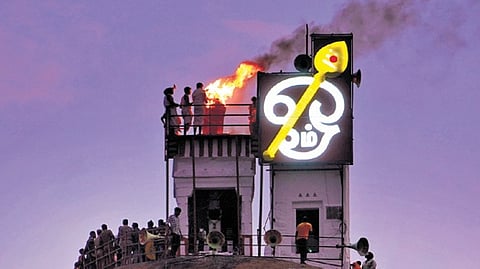

Tamil Nadu’s change of government has brought little change to the Thiruparankundram impasse. Under the DMK last year, a high court direction to light the Deepam at the disputed pillar went unimplemented. Under TVK this year, the Supreme Court’s one-time arrangement met the same fate. The Madurai collector’s apology, attributing the failure to the temple board withholding authorisation, raises a question larger than one official’s conduct. Who takes responsibility when institutions collectively fail to deliver compliance?
The government cannot stand apart from a temple administered within the state’s Hindu religious and charitable endowments framework. Having assured the high court just hours earlier on Tuesday that it would comply with the Supreme Court’s directions, the administration must explain why it did so while the necessary authorisation remained outstanding. Its reliance on the trustees’ refusal risks being seen as an attempt to circumvent the SC order.
There is little purpose, however, in pretending that politics can be removed from a dispute with historical layers. Rival claims over the hill have generated litigation for more than a century. Earlier records mention attempts at lighting in 1862 and 1912, without conclusively identifying the present Deepathoon. Those references establish the age of the controversy, not an uninterrupted practice at this particular pillar.
The political continuity matters too. TVK displaced the DMK electorally without abandoning much of the ideological ground occupied by its rival. Their overlap on secularism, social justice and state rights makes the present stance more than an accommodation of allies. Minority anxieties deserve reassurance, but the Judiciary’s orders cannot be ignored either. After all, the Supreme Court’s permission settled no enduring claim and required protection of existing observances.
Beyond managing the dispute, the government has a duty to preserve the temple’s heritage. Thiruparankundram, celebrated in Sangam literature and revered as one of Murugan’s six abodes, deserves sustained conservation. Its eighth-century Pandya cave temple heritage, partly obscured by later additions, should be made more accessible.
The immediate dispute, meanwhile, is back before the Supreme Court. A contempt petition has been filed after the court declined to initiate proceedings on its own. Whether it finds wilful disobedience, and what consequences follow, remain to be seen. The administration could find itself between a rock and a hard place if the court insists on implementing its Deepathoon order at the earliest.
