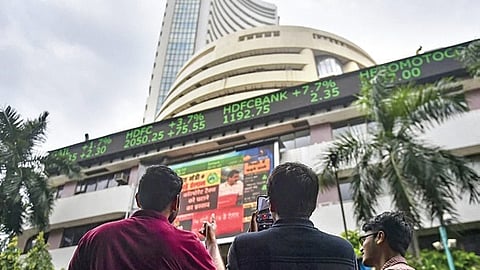

Year 2025 has been volatile for the Indian stock markets. It began with a period of correction and remained under pressure owing to the tariff war, while overvaluations and weak corporate earnings weighed on sentiment. Around this time last year, India was among the three best-performing markets, with one-year gains placing it ahead of Japan, Hong Kong, China, the UK, and South Korea. But with a mere 5 percent rise this year, it’s the worst-performing major global market. All three broad categories—the large, mid, and small caps, which saw strong one-year returns last November—are either flat or in the red. If Nifty 100, Nifty Midcap 150, and Nifty Smallcap 250 delivered 31, 42, and 45 percent returns, respectively, till November 2024, this year the first two segments turned in a marginal gain of 3 percent, while the latter declined 5 percent. The benchmark Sensex, too, has gained only 9 percent so far this year, as against robust growth in 2024. All of this begs the question: can Sensex scale the projected 90,000 level by December 2025?
Analysts believe so, citing a revival in personal consumption and private investments to uplift domestic growth, while improved corporate earnings and easing inflation are set to boost the outlook for 2026. After five quarters of depressed earnings, the coming quarters may see a turnaround, with MSCI India estimating robust earnings growth. Morgan Stanley has set a bull-case Sensex target of 1,07,000 by December 2026. But these projections are based on the premise that oil prices will stay low, global trade shifts will be favourable, and global growth will look up. Importantly, pro-growth policies such as GST rate rationalisation, interest rate cuts, and external sector measures offer key macro support. In other words, there are significant structural positives for the Indian markets.
That said, if 2025 is about staying the course, it’s uncertain if 2026 will get any better as the global markets navigate geopolitical and other risks including recession, the return of inflation, and trade tariffs, all of which may trigger bouts of volatility. A recent Natixis survey found that US institutional investors see a 49 percent probability of a market correction in 2026 owing to fears of an AI-driven tech bubble and concerns over China’s rare-earth dominance. In short, the outlook for 2026 remains clouded. Investors must tread with caution.