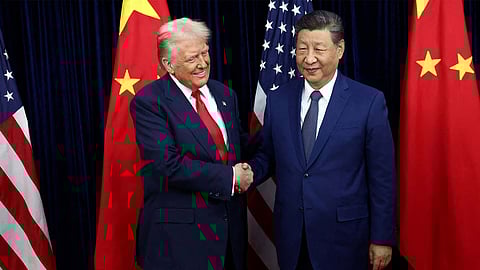

The first face-to-face in six years between US President Donald Trump and Chinese President Xi Jinping was a cautious attempt to steady the relationship between the two largest economies that had been strained more than ever by tariff battles. Absent in South Korea’s Busan was the drama of earlier summits; instead, both sides focused on pragmatic signalling. Trump, characteristically exuberant, hailed the discussion as a “12 out of 10”, while Xi described it more reservedly as a “reassuring pill” for global markets. Between these contrasting temperaments perhaps lay the essence of the encounter—not a real breakthrough but a careful recalibration, and certainly a pause in a long and uncertain rivalry.
The outcome amounts to a truce. Beijing agreed to suspend its export curbs on rare-earth minerals and resume the purchase of American soybean, offering Trump a political win with US farmers. In return, Washington pledged to reduce the average tariff on Chinese imports to 47 percent from 57 percent, and to halve the fentanyl-related punitive rate of 20 percent. China also promised cooperation in curbing the fentanyl menace, giving Trump another domestic talking point. Yet, some underlying tensions remain unresolved. There was no progress on TikTok, semiconductor export restrictions, or broader digital decoupling—vital flashpoints in the tech rivalry that defines the strategic balance between Washington and Beijing.
During his Asia tour, Trump praised Prime Minister Narendra Modi as “tough as hell”, but notably avoided any mention of the Quad, the Indo-Pacific security framework seen as a counterbalance to China’s influence. The silence was telling, reflecting a transactional worldview that favours one-on-one deal-making over a sustained multilateral strategy. For his part, Xi projected quiet confidence. China’s economy appears to have weathered six months of tariff turbulence better than expected, aided by diversification of trade ties, command over supply chains, and control over critical minerals.
For Beijing, Busan provided an opportunity to relieve pressure without making real concessions and maintaining the appearance of constructive engagement. What emerged is more a respite than a reset. The US-China rivalry has moved beyond trade into technology and global influence. Trump may frame the meeting as progress negotiated through recalibrated deals. However, in the coming days, it is more likely to be seen as an intermission—a temporary rearrangement in a contest with no end in sight