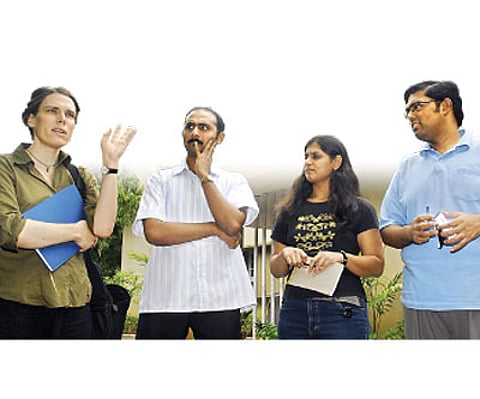

The pursuit of science is at its best, when it is part of a way of life’ says the foundation stone at the Institute of Mathematical Sciences (IMSc), Chennai — an aspired destination for many mathematicians in India. And these words are followed in spirit by the researchers at IMSc. The autonomous institution that was founded by Prof Alladi Ramakrishnan in 1962 focuses on fundamental research in mathematics, theoretical physics and theoretical
computer science.
The 48-year-old institution is unique for more than one reason. It is the only institute in south India dedicated to research in mathematics. When this reporter visited the campus, the professors were busy preparing for the International Congress of Mathematicians. A prestigious event for all maths buffs, the event is being held in India (Hyderabad) for the first time.
Two IMSc professors are executive members of the event, a rare feat for any Indian. Prof R Balasubramanian, the institute’s director and an expert in number theory, is the only Indian to be invited to give a plenary lecture at the event.
Outstanding faculty
The institute has more than 15 of its members as fellows in different
research societies — probably the only research institution in the country with such an honour. “The number of fellows is large compared to other institutions in the country. Even some IITs do not have as many of its faculty in the societies,” claims Prof VS Sunder of the mathematics department. “The standard of a research institution is judged on that in the academic circle,” he explains.
Also, the researchers at IMSc do not confine themselves to mathematics but delve into new fields. Take Prof Ronojoy Adhikari for instance. Though his primary research interest was in foams, emulsions and liquid crystals, he did extensive research on the Indus script, which is not even remotely connected to liquid crystals. Indus script is believed to be a written language used during the Harappan civilisation (that flourished between 2600 and 1900 BC).
Prof Adhikari collaborated with the Indus Research Centre of Roja Muthiah Research Library, Chennai, and Tata
Institute of Fundamental Research, Mumbai, and contended that the Indus script was certainly a language, against those who said it was nothing but a set of symbols.
Interdisciplinary studies
Most of the researchers at IMSc are open to interdisciplinary studies. “When science is constantly evolving, interdisciplinary studies become inevitable. Otherwise, one major will sit alone in isolation,” says Prof Sunder. The interaction between disciplines is a regular feature at the institute. “Interdisciplinary studies provides the knowledge of two subjects. It is the future,” says Maruthi Pradeep, a research scholar. Incidentally, IMSc was earlier known as MATSCIENCE in the academic circle. Quantum biology and quantum mathematics are some of the areas in which research is being pursued.
A researcher’s life
The lifestyle at the institute is definitely the envy of scholars at other institutions. The students and teachers in the campus seem to have made academics their life in a positive sense. “The faculty here enjoy a lifestyle that helps them spend more time on research,” says Prof G Baskaran, a faculty of mathematics. Since, there are no strict timings (unless they have a class), they can mix research and leisure. So, that makes
research a way of life,” he smiles.
The institute focuses more on the theoretical part of physics and computer science. “Many Indian students, who have expertise in the practicals, do not have enough knowledge in the theory part. But, research is not complete without theoretical part,” says Prof Ghanashyam Date, whose research is in classical and quantum gravity. The physics department focusses more on elementary particle physics and condensed matter physics.
Survey misses
Despite having an interesting academic set up and many honours, the institute does not get enough visibility among students. “IMSc is well-known among research
students. That is reflecting in the number of applications we receive
every year. But IMSc is not considered when the surveys are taken as
we don’t have any surveys published
on research institutions,” explains Prof Baskaran.
Though IMSc gets its student population from across the country and even postdoctoral fellows from abroad, a large section of Indian students are from West Bengal and Kerala. “I don’t know the reason
behind it. May be it’s just their preference,” says Prof Date. In recent times, more students have come from rural areas. “It is good to see more students from smaller towns and villages coming here. It is a welcome change,” says Amritanshu Prasad, a mathematics professor.
The institute also attracts many foreign students for their postdoctoral programmes. “IMSc is well-known in the academic circle. Also, I like being in India,” says Jeanne Scott, a postdoctoral fellow from England. “Another good thing about academics is that, one can travel a lot,” says the British mathematician scholar, who is researching in kolams in combinatorics. IMSc also conducts summer schools and exhibitions on National Science Day (February 28) every year. “This year, we had many students from the nearby schools who had fun experiencing the simple wonders of science,” says Adhikari.
Envious lifestyle
The institute has 20 per cent of women in its faculty and more students in mathematics compared to other two streams. “The numbers are going up now,” says TP Sriluckshmy, a first year PhD student.
So how does the research scholars feel about their friends in the corporate sector earning a ransom? “We don’t feel bad at all. On the contrary, my friend, who is working with an MNC and earning a lot, feels bad that he is not here and enjoy the lifestyle that we have,” says Somdeb Ghose, a fourth-year PhD student of theoretical physics. “We do not do it for money. It is the lifestyle that we like here. At IMSc, research is very much part of our lifestyle,” Prof Sunder asserts.
So what are the job opportunities? “Usually students who study here go on to become teachers in research
organisations either in India or abroad. But, even then, they will continue their research,” says Maruthi Pradeep.
Facilities
The six-and-a-half acre residential
institution, aided by the department of atomic energy, is one of the 15 such
institutions for research in India. It has 58 faculty members and around 75 students. It has fully air-conditioned offices, library, international guest houses and hostels for men and women students. The library has more than 55,000 books under various sections, around 350 journals in print and access to more than 3,000 online journals.
The focus on interdisciplinary studies is very much evident even in the library. “Most often, students from mathematics stream borrow books from physics and computer sciences and vice versa,” says Dr Paul Pandian, the librarian.
How to get there?
IMSc offers postgraduate courses like MSc and research programmes like PhD and postdoctoral fellowships.
Admission into these courses is through the Joint Entrance Test (JET) conducted by the National Board of Higher Mathematics and a personal interview at IMSc. It also offers summer schools for interested students. More details on www.imsc.res.in
— dennis@expressbuzz.com

