
Digital cameras have really made it easier for people to shoot pictures, and the concept of clicking a pre-planned shot has become more or less obsolete. This also leads to too much garbage in the market, with youngsters, who have no training or knowledge giving bad quality work. But if you have the passion and the right training to mould you, photography can be a very
rewarding option.
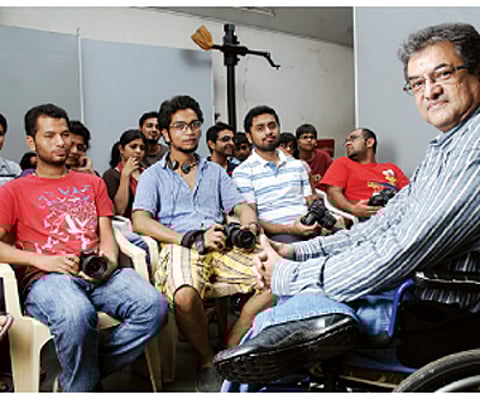
Started in 1991, Shari Academy of Professional Photography and Digital Imaging, Mumbai, is Girish Mistry’s tribute to the profession that defined him — Mistry, a photographer since the ’80s has specialised in jewellery, fashion and children’s photography, front projection technique and special effects. His clientele included the who’s who of Indian and international brands like Tata, Reliance, Jindal Steel, Nina Ricci, Christian Dior, Swatch, Deutche Bank, Maruti, HDFC, Lintas, O&M and Percept. A personal tragedy in 1990 rendered him paralysed waist-down.
Mistry began with workshops for batches of eight, three and once, only one student! But he realised what the workshops meant for his students, however few and kept going. Today, 20 years down the line, Mistry is glad he didn’t give up on photography or his life.
Courses offered
Shari is India’s only Adobe certified training centre and is backed by Canon. A master’s course in photography abroad will usually comprise four years on campus, three years of internship and one-two years to make a portfolio. This has been cut down to two years at Shari. “When you open your fist with knowledge is when they (students) will trust you. I’m not afraid of imparting this knowledge,” says Mistry, the 50-year-old photographer and dean of Shari Academy.
Shari provides a mastercraftsman diploma for two years, a 10-month diploma in fashion and portrait photography and a three-month apprentice diploma in digital studio portrait and event. These courses study digital workflow, light sources, people photography and studio flash lighting, studio portraits, digital photography, colour management workflow, portraiture, advertising, photography software, graphic design, digital marketing, studio operations and portfolio development.
The three-month diploma costs `36,000 and you’ll have to spend `4 lakh to earn the mastercraftsman diploma. You can join right after Class 10. The basic requirements are interest and passion for photography. While Shari offers short-term programmes on specialised fields in photography, its dean doesn’t believe in crash courses on basic photography — hence the two-year mastercraftsman diploma. “You can’t teach the whole gamut of photography in six months. If the shot isn’t good enough, you can’t work miracles on Photoshop. Minimal post production shots will only be taken by a professional and that’s the expertise we try to give our students,” says Mistry.
Campus scan
Shari uses state-of-the-art equipment to teach and practice photography like Sinar and Horseman 5X4 view cameras, medium format cameras, Canon with L series lenses, Canon digital cameras, Minolta flash meters, ring flash and Ranger outdoor power packs. The library houses more than 700 books, videos and CDs. Their digital lab also is equipped with high-end computers, scanners and cameras. There is free access to propshop, backgrounds and sets. “We slam the students with tremendous amount of lighting knowledge and techniques so that they have a holistic education and can use this knowledge in any field they decide to specialise in,” says Mistry.
Each batch is restricted to 30 students. “The reputation of Shari is the main reason I joined this place. There is also a lot of creative freedom. While the basics are taught to you, he (Mistry) does not impose his style on you,” says Tanvi Bhadre, a first-year student. Her classmate Vikrant Oulkar echoes her view. “There are a lot of institutes in India to teach photography. But the exposure and the faculty make this place one-of-a-kind. Mistry is a disciplinarian, work-wise, but otherwise, he’s one of our friends,” he says.
Future of photography
Photographers find employment in fashion, publishing and media houses, with fashion designers, ad agencies, the film industry, in fine art and even in scientific fields. Forensic photography, industry and commercial photography, fashion and portrait photography and photography journalism are some of the fields where people can apply their photography skills. Akash Kasar, who graduated last year, is now an assistant to famous photographer Nrupen Madhvani. “You are valued for being a Shari product. The basics are taught well and the rest depends on your portfolio,” he says.
Take two with students
Mistry enjoys interacting closely with his students. His friendly demeanour and the casual and open atmosphere at Shari helps bring out the best in students. But the disciplinarian in him comes out to drive his students to perfection and better work. He enjoys the young energy around him. Zaryan Patel, a final-year student, employed the skills and knowledge gained at Shari in cinematography in “Not a love story”, a film he made at FX School, Mumbai. “Girish sir is my mentor. He has given me time off to shoot my movie. We have a tight schedule here at Shari where a four-year curriculum is packed into two but he still gives us space to explore our creativity,” comments Patel.
Alumni
Shari has a track record of over 2,000 students from India and abroad. Shari’s alumni include some very popular names like fashion photographers Vikram Bawa and Prateek Singhi. The alumni also have been involved in workshops conducted at the academy. “I had initially joined Shari for an eight-month course in fashion photography. But I was so impressed that I went on to pursue their two year course as well. Girish sir’s background in photography and the exposure you get in Mumbai are the reasons I chose Shari. They give students a great foundation and the name really helps while you are interning. Post internship, the skills you have acquired from the institute will help you create your portfolio, which will speak for you. Girish Mistry is an amazing teacher, is straight forward, unbiased and has a great sense of humour,” says Singhi, who is all praises for Shari Academy.
Faculty
Girish Mistry pulls in some of the best from the industry to teach his students. Rohinton Irani, Vishal Bhende, Fawzab Husain, Swapnan Mukherjee, Hridgandha Mistry and Jesal Bhuta, all popular in their own fields. Their visiting faculty members include Atul Kasbekar, Anil Gandhi, Ian Pereira, Jagdish Agarwal, Jaideep Oberoi, Jignesh Zaveri, Preeti Bedi and Vihang Vasa.
Placements
Although placements are not assured at Shari, they do guide their students with respect to jobs and offer a lot of industry exposure. So are the students worried about placements? “We are sometimes scared, but the industry is big and it all depends on your portfolio and skills,” says Bhadre.
There are students who fail at Shari, unlike most places where photography is provided as a certificate course, because they insist on good quality work. The final assignment is judged by an external jury. The students seem to agree that it is eventually your work that will speak for you. Freshers get paid very little in the beginning, probably just travel and food, but this is a field where one must go through the learning curve.
What else?
Photo fairs and weekend workshops for amateurs and semi-professionals are regularly held by Girish Mistry. To participate in the workshops, email shariacademy@yahoo.com. Shari also has a blog (www.shariblog.com), where students post their wide array of photographs. The portal also talks about gadgets, tips, projects, quizzes, press releases and the works. It has over 77,000 members today, with contests and free space to showcase talent.
The annual Kala Ghoda arts festival held in Mumbai, is another place where talent from Shari is exhibited to the outside world. The festival focuses on film, theatre, art, literature, dance, workshops and exhibitions.
For someone who has gone bankrupt twice in the last two decades, Mistry is not a man who regrets setting up Shari. He finds meaning in imparting knowledge and has consistently maintained good quality in students. Shari is a brand that is recognised by people, largely for its talented graduates and, of course, their mentor.
— preethi@newindianexpress.com