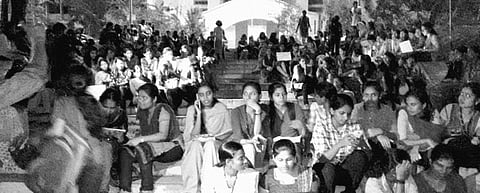

Break the Curfew’ campaign of the girls of College of Engineering-Thiruvananthapuram (CET) has been grabbing headlines for a while now. Their grouse is that while male students don’t have a curfew, female students have to return to their hostels by 6.30 pm, which is not just wrong because it is gender biased, but it is also preventing them from using the facilities on campus like the library.
“Even NIT-Calicut, which is on the outskirts, doesn’t have such a curfew. Students can report to hostels by 9 pm. Our institute is close to the Indian Institute of Science Education and Research and Technopark (an IT Park) where people do night shifts. There is no disparity there in the name of safety. Moreover, the city police commissioner has promised increased patrolling around the college. But our management says a decision would be taken only after a committee meeting with students, teachers and parents,” says Aswathy R, a final-year student of Applied Electronics and Communication.

A different rule for girls and boys is not unique to CET, explains S Vaidhyasubramaniam, Dean, Planning and Development, SASTRA University, Thanjavur, Tamil Nadu. “We ask our girl students to return to their hostels by 7 pm. Students need to understand our worry as the outside world is not within our control. Whether something happens to students on or off the campus, parents hold us responsible. Most students give the oft-repeated excuse that the curfew hampers them from using the library. But when I arranged a shuttle for them to take them to the library and back to the hostel after curfew hours, I found to my dismay that hardly one or two students were using the shuttle,” he reasons.
Aswathy too admits there are safety issues in CET and they are campaigning for additional security on campus in addition to the curfew time being extended. “I candidly confess that security on campus is not to the desired level. For a huge 120-acre campus, we have just three or four guards manning the area. There are multiple entry points left unguarded, walls that require strengthening and so on. The reason cited by the college is that they don’t have funds, which is hard to believe, as this is a government institute and it wouldn’t have much difficulty in procuring funds, that too for an important issue like safety. Even Shashi Tharoor (former Union Minister of State who represented the Thiruvananthapuram constituency) has said that he’d help with coordination of funds if the college desires. But the management is just sleeping over the issue,” she complains.
This begs the question why institutes like IITs and IIMs don’t have any gender-specific curfews. Is it to do with the better facilities and security on campus?
Debashis Chatterjee, Former Director, Indian Institute of Management, Kozhikode, which has been known for its better representation of women compared to its contemporaries, says, “Better security facilities don’t give a college the right to be free about rules. Safety is the rule. There can be no second opinion about that. IITS and IIMs are, by nature, cosmopolitan. The maturity levels of students and faculty are higher. There is far more acceptance of gender and diversity and perhaps that is why we don’t waste our time playing moral police.” says Chatterjee, who is at present teaching at IIM-Lucknow.
In most engineering colleges in Tamil Nadu, you would see Adam avoiding his classmate Eve not because they are enemies but that is the way things are here. Forget interacting with the opposite sex and instead focus on academics is the message from college managements and parents alike. “Students get involved in unnecessary affairs, which threaten to scar their academic lives and their career prospects. We are just trying to prevent untoward incidents rather than doing a post-mortem later. There is a lot of time afterwards to indulge in fun or whatever they think we are restricting them from,” says the managing director of a private engineering college in Dindigul, Tamil Nadu.
Vaidhyasubramaniam says students sometimes make a big deal about trivial things. “You don’t question the dress code in school or office. But you question the dress code in colleges!” he exclaims.
College admissions are a family affair in India. What do parents have to say about the curfews and the rules that prohibit interaction with the opposite sex? “You can say I am old school as it is natural for me to be worried if my daughters were to return a little late from school/college/office. You hear of scary instances of rape and molestation in the newspapers. I would love for my child to be protected first rather than cry hoarse about feminism or being a rebel. I understand that it is not the government, but college managements, that set hostel curfews and prevent girl-boy mingling. But as long as children reap the benefits of the education they set out to gain, I am fine with the rules,” says Jayanthi Venugopal, a mother of two.
Whatever the argument is, there are holes in them, as this student points out. “Why not allow the men also to be indoors by 7 pm or whatever the curfew time is? The state does not distinguish between gender, say, when you are on trial for murder. Murder is murder irrespective of who does it. Also, this segregation of sexes is a very unnatural and unhealthy system. Most of the schools here don’t have such rules. Suddenly you are thrust into a college environment where it is taboo to talk to a person of the opposite sex. This will only result in two possible outcomes — one where boys make fun of girls as they are naturally curious about the opposite sex and two, where boys and girls attempt to talk to each other clandestinely,” says Nila (name changed), who graduated from a private engineering college off Sozhinganallur, Chennai, last year.
While the girls of CET are sure their campaign will bear fruit, how far things will improve with respect to gender equality in colleges is to be seen in the coming years.
— shilpa.vasudevan@newindianexpress.com