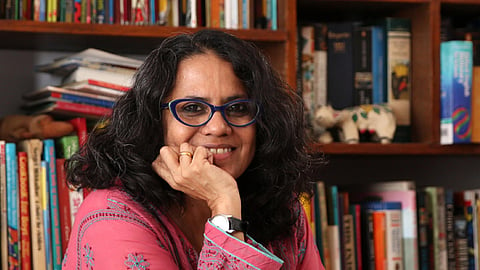

After novelising the movie Dhanak, author Anushka Ravishankar, the reigning queen of nonsense literature, talks to Seema Rajpal about reading, students and more
What do you do when you specialise in the genre of nonsense literature (think Alice in Wonderland), attempt to explain the same to laymen and are asked not to call your own work ‘nonsense’? Surely it can’t be that bad? What do you do when your own friends don’t understand your genre and constantly ask you “What is this? What are you doing?” You do what acclaimed authors do. Go on to pioneer the genre in India; write more than 25 books for children; set up your own publishing house and somewhere along the way win international awards and acclaim. But when you are author Anushka Ravishankar after achieving all this, you go another step ahead. You take up the challenge of novelising a movie in just seven days!
All in a week’s work
The 55-year-old author, effectively puts an end to the eternal book vs movie conflict by stating “It’s not about ‘the book is better or the movie’. The book should be enjoyed as a book and a movie should be enjoyed as a movie.” This discussion started with the premise of the author completing her first novelisation of a movie — Nagesh Kukunoor’s Dhanak and publishing it as well. After making the right kind of noise and picking up awards at international film festivals like Berlin last year, Dhanak finally hit cinema theatres of the country recently. Needless to say, the touching story about the quest a sister undertakes to help her brother see again, not only brought back Iqbal-like vibes, it proved to be a hit at the box-office too. So converting this successful story certainly must have come with its own perils? “I did not want to change any part of the director’s plot but certain elements like the thought process of the Chachi (the sister’s aunt) had to be explained for a better understanding of the character’s motives behind her actions,” says the author who is currently in Gurugram and is in the process of moving to Chennai. After the book was launched and read, the greatest compliment came from none other than Kukunoor himself! “He said he teared up while reading,” she divulges.
Straying from sense
As a child, Ravishankar’s nose was always buried in a book, reading anything she could find in small town Nashik, where she was born. Being a 70s child, her voracious appetite was satiated with Enid Blyton and Hardy Boys initially. “The young adult category wasn’t there so I very quickly graduated to adult books, those rubbishy thriller kinds. Then I grew older and read more serious stuff,” says the author who describes her earlier reading habits as erratic. But the first time she read Alice In Wonderland, the pioneering book in the nonsense literature genre which she would eventually conquer, the characters freaked her out, she confessed. But that was then, and this is now — where she is called the Dr Seuss of India. “I like my verse to be slightly irregular and offbeat, in that sense, I think my writing reminds people of the writing of Dr Seuss,” says the author, clearly embarrassed for the comparison with the path-breaking American writer.
To put things into perspective, nonsense literature is the fine art of balancing logic with the illogical by defying sense or flouting convention. “There is not much market for it in India. It’s a strange genre, not for everybody. It’s like a sense of humour either you have it or you don’t. A lot of people have looked at the nonsense I have written and asked me why I do this. I say nothing. It’s like telling somebody a joke and they just don’t get it!” says the author, exasperated. While nonsense literature is an acquired taste, writing for children is no child’s play either. “You have to have a memory of how it was like to be a child and you have to write from that memory. It’s not a special ability, it’s just either you have it or you don’t,” says the writer of Excuse Me, Is this India?
Doing it her own way
In the need to fill up the otherwise void space of fiction for Indian children, in 2012, Ravishankar, along with colleague Sayoni Basu, set up her own publishing house — Duckbill Books. Working with brands like Tara Books and Scholastic India gave her the expertise and propelled by her aim, drove her to find more writers in the genre of children’s literature. “Publishing houses have targets and they have to do a lot of folk tales, mythology and other genres. So we, after conducting a few workshops for upcoming authors of children’s book, set up our own publishing house. We are constantly on the lookout for good, unusual content, especially contemporary fiction and urbane historical fiction,” she explains.
Children of today
Speaking of children, does Ravishankar fear that kids are reading lesser these days? “The number of children who are reading, if anything, has gone up. Thanks to the schools for encouraging them to be proactive when it comes to reading,” she opines. What she does fear is children losing the ability to communicate complicated thoughts, thanks to all the short forms they use while texting. After all, communicating convoluted concepts is also a task and “you can’t do that through these short forms,” she says. And though she doesn’t have a problem with the world switching to e-books she personally would rather read a gold, old hard copy. “I do read on the screen. The kind of books I prefer to read on the iPad are the ones I don’t mind not owning. Somehow the trend of reading on a Kindle is still not there for many of us. It’s just reading material, it’s not a book,” she confesses, echoing many of our views about reading on screens.
“Writing for children is not something you should do if you need to earn a living in India,” she warns towards the end. “But on the other hand, we do need more writers too. So, I truly feel that those who really want to write, will, and those who really don’t want to write shouldn’t,” she concludes.

