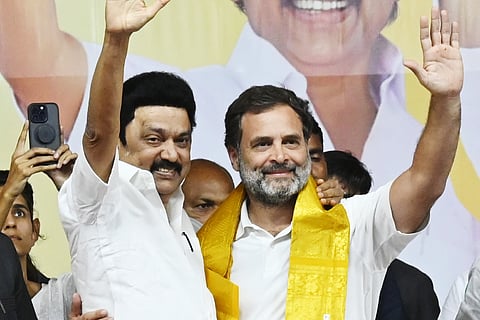

Tamil Nadu Chief Minister and Dravida Munnetra Kazhagam president M. K. Stalin has expressed satisfaction after his party and the Indian National Congress finalised a seat-sharing agreement for the upcoming Tamil Nadu Assembly election, a development that the ruling Dravida Munnetra Kazhagam believes will strengthen the alliance’s prospects of securing another mandate in the state. The agreement brings to a close weeks of negotiations between the two parties and reaffirms the continuation of the DMK-led coalition that currently governs the state.
Under the agreement, finalised after weeks of negotiations, the Indian National Congress will contest 28 of the 234 Assembly constituencies, while the Dravida Munnetra Kazhagam will fight most of the remaining seats and allocate the rest to its allies.
Stalin described the pact as a positive step that reflects the enduring partnership between the DMK and the Congress, two parties that have shared an electoral understanding in Tamil Nadu for several years. According to the chief minister, the agreement demonstrates that the alliance partners are united in their objective of continuing the governance model that the DMK government has sought to project as socially inclusive and welfare-oriented. The DMK leadership has repeatedly emphasised that the coalition represents a broad political platform committed to secular values and social justice, themes that have traditionally defined the party’s ideological positioning.
The seat-sharing formula allows the Congress to contest a limited but strategically chosen set of constituencies while the DMK retains the dominant share of seats within the alliance. Although negotiations between the partners were at times tense, particularly over the number of constituencies and the broader role of the Congress within the coalition, both sides ultimately opted for compromise in order to avoid fragmentation within the ruling front ahead of a crucial election. For the DMK leadership, maintaining unity within the alliance was seen as more important than allowing differences over seat allocation to escalate into a political rupture.
"We believe that this pattern reinforces the value of the alliance, with the Congress and the other regional parties converting a limited number of seats into a significant contribution to the coalition’s tally," says a party source, who is not authorised to talk to media.
From the DMK’s perspective, the continuation of the alliance with the Congress serves multiple strategic purposes. While the Congress does not possess a strong independent organisational base across Tamil Nadu, it still retains pockets of influence in several districts and among specific social groups. By retaining the Congress within the coalition, the DMK hopes to consolidate support among minority communities and segments of voters who remain aligned with the Congress’s national political identity. The presence of a national party in the alliance also enables the DMK to frame the coalition as part of a broader political platform that stands in opposition to the Bharatiya Janata Party at the national level.
The ruling party’s confidence also stems from the electoral performance of the alliance in the previous Assembly election. In that contest, the DMK emerged with a decisive victory and formed the government with a comfortable majority in the 234-member assembly, while the Congress, despite contesting a smaller number of seats, recorded a strong strike rate. The DMK leadership believes that this electoral pattern demonstrates the practical value of maintaining the partnership, as the Congress has been able to convert a relatively small number of seats into a meaningful contribution to the alliance’s overall tally.
Beyond arithmetic, the DMK views the alliance as an important part of its broader political narrative. The party has consistently framed its governance approach as the continuation of the Dravidian political tradition that emphasises social welfare, state autonomy and inclusive development. By keeping together a coalition of regional, national and left-leaning parties, the DMK hopes to reinforce the perception that it represents a broad ideological front rather than a narrowly regional political formation.
At the same time, the party is aware that the upcoming election may be more competitive than the previous one. The principal opposition bloc led by the All India Anna Dravida Munnetra Kazhagam and supported by the Bharatiya Janata Party is expected to campaign aggressively against the ruling government. In addition, new political players are seeking to expand their presence in the state’s political landscape. Among them is the party launched by actor-politician Vijay, whose entry into electoral politics has generated considerable public attention and could influence voting patterns among younger voters.
Despite these emerging variables, the DMK leadership remains confident that the alliance structure it has put in place will provide a significant organisational advantage during the campaign. The party believes that the combined strength of its coalition partners, along with the incumbency of the state government and its welfare programmes, will help consolidate voter support across multiple social and regional constituencies.
For Stalin and the DMK, the finalisation of the seat-sharing agreement is therefore not merely a procedural step in election preparation but a signal that the coalition which brought the party to power remains intact. By presenting a united political front well ahead of the election campaign, the DMK hopes to project stability and continuity, while positioning the alliance as the most credible platform capable of securing another term in office in Tamil Nadu.
