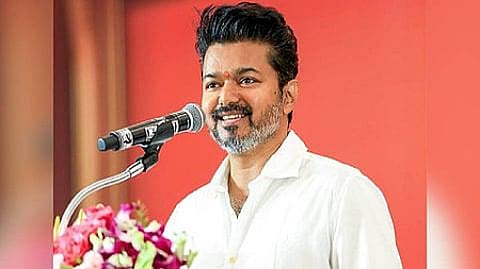

Speculation over whether actor Vijay’s political party, Tamilaga Vettri Kazhagam, could join the National Democratic Alliance in the run-up to the 2026 Tamil Nadu Assembly election has generated considerable political discussion in the state. The question has gained prominence as political parties begin recalibrating their alliance strategies ahead of the polls. While some leaders within the NDA have publicly indicated that they would welcome Vijay into the alliance, the available political signals suggest that such a development remains uncertain and, at this stage, appears unlikely.
Tamil Nadu’s political landscape has long been shaped by the dominance of the Dravidian parties, particularly the ruling Dravida Munnetra Kazhagam and the principal opposition All India Anna Dravida Munnetra Kazhagam. National parties have historically found it difficult to secure a significant independent presence in the state and have therefore relied on alliances with regional players. In this context, the emergence of Vijay’s party has introduced a new variable into the political equation, raising questions about whether it will align with one of the established coalitions or attempt to chart an independent path.
Since announcing the formation of Tamilaga Vettri Kazhagam, Vijay has sought to position his party as an alternative political force rather than as an appendage to existing alliances. The party’s leadership has indicated that its objective is to build a distinct political identity capable of appealing to voters who may be dissatisfied with both the ruling DMK and the traditional opposition represented by the AIADMK. This positioning has led many political observers to believe that TVK is more likely to contest the election independently in order to consolidate its own political base.
At the same time, the possibility of an alliance with the National Democratic Alliance continues to be discussed in political circles because such a move could potentially reshape the electoral arithmetic. The NDA, which includes the Bharatiya Janata Party and its regional partners, has been attempting to broaden its coalition in Tamil Nadu as part of its effort to challenge the dominance of the DMK-led front. Bringing a high-profile figure such as Vijay into the alliance could provide the coalition with greater visibility and help attract younger voters as well as sections of the electorate that may be receptive to a new political narrative.
From the perspective of the NDA, an alliance with TVK could help consolidate anti-DMK votes that might otherwise be divided among multiple opposition parties. In a state where electoral outcomes often hinge on the strength of alliances, even a modest shift in vote share can significantly influence the final result. Vijay’s popularity, particularly among younger voters and urban audiences, is therefore seen by some political strategists as a potentially valuable electoral asset.
However, the political calculus for Vijay and his party is more complex. Aligning with the NDA could provide organisational support, campaign resources and an established coalition structure that might help a new party navigate the challenges of a high-stakes Assembly election. At the same time, such an alliance could undermine TVK’s attempt to present itself as a fresh alternative to the existing political formations. Entering into a pre-poll alliance with a national party may risk diluting the party’s message of political renewal and independence, particularly among voters who are drawn to Vijay’s image as a new entrant seeking to reshape the state’s political landscape.
Another factor influencing the debate is the ideological positioning adopted by TVK since its formation.
"The party has attempted to maintain a carefully balanced stance in relation to the major political forces in the state, signalling that it does not intend to align itself unconditionally with either the DMK-led bloc or the NDA. This approach appears to be aimed at preserving political flexibility while allowing the party to build its organisational network and support base across different regions of the state," says a senior political observer in Chennai.
Despite the continuing speculation, there have been no formal indications of negotiations or alliance discussions between TVK and the NDA leadership. Much of the talk about a possible tie-up has emerged from political commentary and exploratory remarks by leaders from various parties rather than from confirmed developments within the two organisations. For now, Vijay’s party appears focused on strengthening its organisational structure, expanding its grassroots presence and preparing for the possibility of contesting the election on its own.
As the Assembly election approaches, the question of alliances will inevitably become more prominent. Political calculations can shift rapidly in the final months before polling, particularly if parties believe that strategic partnerships could improve their electoral prospects. While the possibility of TVK joining the NDA cannot be completely ruled out at this stage, the current indications suggest that Vijay is more inclined to project his party as an independent political force seeking to create a new space in Tamil Nadu’s highly competitive political arena.
The coming months will therefore be crucial in determining whether TVK ultimately opts for electoral independence or decides to align with one of the established alliances. But any move by Tamilaga Vettri Kazhagam towards joining an alliance could have a significant impact on the state’s political landscape.
“The choice will not only influence Vijay’s own political trajectory but could also shape the broader dynamics of the 2026 Tamil Nadu Assembly election, where the emergence of a new political player has already begun to alter the contours of the state’s electoral contest,” said the political observer, who believes that the party appears keen to maintain a carefully balanced stance on alliances for now.
