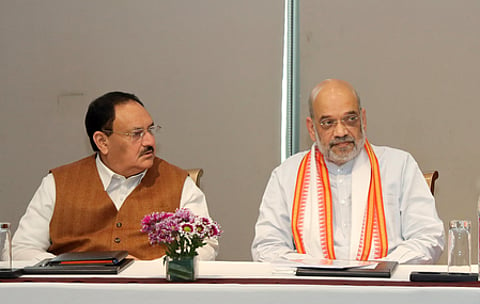

Union Home Minister Amit Shah on Wednesday visited the residence of JP Nadda, the former president of the Bharatiya Janata Party (BJP), in New Delhi for a high-level meeting expected to focus on preparations for the upcoming West Bengal Legislative Assembly election.
The meeting is seen as part of the BJP’s early efforts to sharpen its electoral strategy in a state that remains a major political battleground. Senior leaders are likely to review campaign planning, organisational mobilisation and possible timelines for candidate selection as the party prepares to intensify its political outreach in West Bengal. Members of the BJP’s West Bengal core committee are also expected to participate in the discussions, signalling a more detailed review of the party’s ground-level readiness.
For the BJP leadership, West Bengal continues to be both a strategic priority and a political challenge. The party made significant gains in the state during the 2019 Lok Sabha elections and emerged as the principal challenger to the ruling All India Trinamool Congress led by Chief Minister Mamata Banerjee. However, it was unable to translate that momentum into victory in the subsequent Assembly election. Since then, the party has been attempting to rebuild organisational cohesion in the state while expanding its support base among different social groups.
The involvement of Shah in the meeting is particularly significant given his central role in the BJP’s election management strategy over the past decade. Party leaders believe that a coordinated push involving the national leadership and the state unit will be necessary if the BJP is to mount a stronger challenge in the next Assembly election.
The political discussions also come amid fresh developments in the election administration framework. The Election Commission of India, under Chief Election Commissioner Gyanesh Kumar, has indicated that it will deploy central armed police forces and appoint a large number of observers to oversee the conduct of polling in West Bengal. Such measures are intended to ensure a neutral and secure electoral environment in a state where elections have historically been marked by intense political rivalry and concerns over violence and intimidation.
The decision to strengthen security deployment and monitoring mechanisms is likely to influence the political calculations of all major parties. For the BJP, which has frequently raised concerns about electoral violence in the state, the move could be viewed as an opportunity to push for a more level playing field. For the ruling Trinamool Congress, the focus will remain on defending its organisational stronghold across districts and maintaining its political dominance.
The strategy discussions at Nadda’s residence therefore reflect the early stages of a wider political exercise. As the election approaches, both the BJP and the Trinamool Congress are expected to intensify their organisational preparations, with the contest once again shaping up to be one of the most closely watched state elections in the country.
