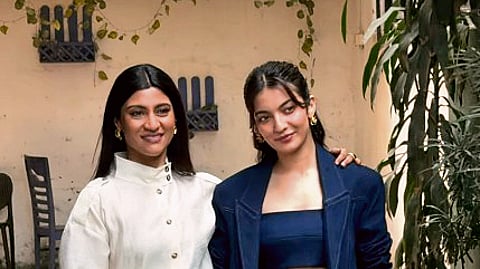

There are so many layers to your character in Netflix’s Accused. A queer woman who is a doctor accused of sexual misconduct, who is also fighting patriarchy at work.
I enjoyed playing Geetika. You can’t paint any human being with just one brush, and that’s what’s so nice. You can’t only look at her as, you know, she’s a woman and therefore that’s her only identity. She’s also the dean of that hospital and a highly successful career woman. Other than that, she’s also a romantic partner to somebody, and then she is also an accused. There are so many layers to the character; it has so much depth and nuance. It is a very interesting psychological exploration of one woman’s word against another’s.
Apart from being a woman, Geetika is also queer, for which she is further judged.
The thing is that it happens, but I feel like we shouldn’t be looking at somebody with only that lens. We are not asking to erase it at all. It is shown as a matter-of-fact thing that she happens to be female, and she happens to be queer, and therefore that, of course, affects her life. In films, you hardly ever see people who are differently-abled unless it’s a main character. It’s like these people don’t populate our world, different kinds of people. So it’s not the core issue, but it is one of the many layers, as I see it.
What continues to draw you to complex female characters?
That is because women do live in complex zones, like all of us. So in that sense, I’m very lucky that I’ve been offered such roles. Women do exist in many different spheres; not all of them are the same. They have different experiences. I think it’s just a kind of reflection of my upbringing and my personality. I’m probably drawn to these things more because they kind of ring true. These are organic choices; one can’t really plot that evolution.
It’s fun to use your imagination and inhabit different characters. It’s such a creative process and very liberating.
You are also a writer and filmmaker. There is a certain inclusivity in your storytelling. Do you now feel a sense of authority and ownership of your career from the time you began?
I don’t know how much control, in that sense, we have over our lives and how our lives intersect and unfold. Of course, we have some kind of choice from moment to moment, but it’s so much a question of how things come about. They are often so miraculous and convoluted. It’s very strange how sometimes life unfolds. I’ve really always been a person who’s kind of gone with the flow. I just try to do, by and large, what resonates with me and makes me feel comfortable. I work where I can be myself and make largely authentic choices, or at least find that kind of space for myself.
I’m hardworking, and I’m sincere, and all of that, but a lot of it is also luck. Many talented people don’t get the break they deserve. I am much more comfortable with the idea of me being an actor, because for the longest time, I was in denial about whether it was the right space for me. It’s after I had my child and got back to working that I really appreciated what I do.
How much do clothes contribute to your characters?
I do think the clothes make a big difference, because even during Mr. and Mrs. Iyer, I found it easy when I wore the yellow sari. So here also, those kinds of suits and blazers—things which are rarely worn in my shooting life. When I would put those things on, it would give me a certain feeling walking down the corridors of that hospital. I’ve not done a lot of roles like that; so with that kind of power and authority, I leaned into it.
Accused is very different from your last Laapataa Ladies. What drew you to Mira, a queer woman who is not out to her family?
It was so beautiful for me to just be in that space where Mira, in love with Geetika, is trying to hold it strong even when their relationship is crumbling. Her family is in India, and she can’t talk to her family about her sexuality. She’s also exploring herself. I think it was a very interesting space for me to be in as an artist, to understand so many layers.
As someone so young in your career, it is a difficult character choice that could invite controversy.
I just view it from one lens — that I love representation and I love stories, even as an audience, where I can feel heard and seen. So I would love to do something where I am able to bring somebody’s story on screen and give life to that.
I do feel that because there is so much awareness around us now, we tend to experiment a lot, which I really enjoyed doing. And with the right team, you are able to trust even more. I really wanted to work with both Anubhuti Kashyap and Konkana, and it helped me grow as an artist. I’m looking forward to doing more such characters, more layered performances. It’s so satisfying.
What was it like working with Konkana?
She is so inspiring, and I would like to share how she always carried a notebook with her on set. She is like a good student, and that’s so motivating.
Having worked with Kiran Rao and Anubhuti, what lens do female directors bring to the story?
I am very grateful to work with two wonderful directors. Working with women directors brings a sense of familiarity. Also, the characters that I have played — Jaya and now Mira — are so layered and nuanced that when you have a woman director with you, their approach feels relatable. Because at the end of the day, we do live similar experiences, so the understanding becomes easy.
