
It was an apt coincidence to have watched Pierre Saint Martin Castellanos’ We Shall Not Be Moved quickly on the heels of Sriram Raghavan’s Ikkis. Like the Indian war drama, Mexican filmmaker Castellanos’ Spanish language debut feature is about individuals and families haunted by the violence and tragedies of the past. Both are about the ideas of crime, justice and punishment, guilt, penance and atonement and, most of all, the strength and freedom that are deeply embedded in the kind act of forgiveness.
We Shall Not Be Moved also parallels Brazilian icon Walter Salles’ I’m Still Here in how it blends the personal with the political. Not only do the two titles have a familiar ring, both draw from reality, the horrors that ordinary folks and families had to face at the hands of the oppressive, dictatorial regimes in their countries in the 60s and the 70s respectively and the memories that refuse to fade away with time. Both the films are about the inability to find a legal recourse with women leading the fight to get justice for their near and dear ones.
We Shall Not Be Moved is inspired by Catellanos’ own mother who had lost her brother in the 1968 Tlatelolco Massacre in which the state forces opened fire on the unarmed university students demanding democracy and justice in a peaceful protest in Mexico City's Plaza de las Tres Culturas.
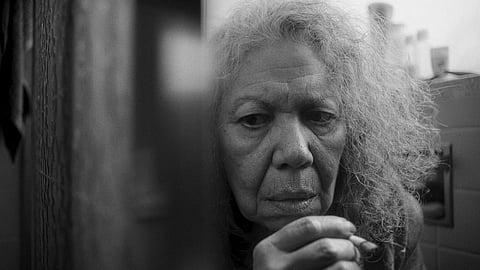
The centre of Castellanos’ film (co-written by Iker Compeán Leroux) is Socorro Castellanos (Luisa Huertas), a retired attorney committed to finding the soldier responsible for killing her brother Coque in this violent act of repression. Despite being a lawyer herself, she cynically admits law is only for the rich and the powerful. Her commitment to the cause has strained her relationship with both her sister Esperanza (Rebeca Manriquez) and her son Jorge (Pedro Hernández). His hardworking wife Lucía (Agustina Quinci), however becomes Socorro’s unlikely confidant and ally. Things come to a head when she gets a clue to the identity of the soldier and makes an absurd plan to avenge her brother’s death, seeking help from the building’s handyman Sidarta (José Alberto Patiño). “It’s a sin to forget those we lost,” she says. Exact retribution—eye for an eye--is all she wants.
The film had its world premiere at the Guadalajara International Film Festival, where it won Best Mexican Film and the Audience Award. It was Mexico’s official submission for 2026 Oscars in the Best International Feature Film category and had the longest theatrical run among all the Mexican films of the year.
What starts seemingly as a revenge drama gradually becomes more nuanced as it builds towards a heartwarming finale. The plot is tightly knit with moments of unexpected dark humour, especially involving a cat and pigeon game in which Socorro becomes a willing participant.
She is the carrier of the film’s message with Luisa Huertas performing the character with tremendous felicity and finesse. Her vivid, vulnerable, expressive face offsets the resolute, cussed, unbending persona, making for a powerful physical presence on screen.
The production design by Alisarine Ducolomb, art direction by Omar Conde and costumes by Dalia Rosales are as significant, going hand in hand with the striking black and white cinematography by César Gutiérrez Miranda, all of them together pointing at the continued hold of the past in the present lives of the people, not just as stuff of nostalgia and sepia photos but a lingering loss, grief and pain and unresolved traumas—individual, familial and collective. Not just of a nation but of humanity at large, as Lucia confides in Socorro about her grandparents who were revolutionaries against the Argentinian dictatorship and had disappeared without a trace.
The powerful, intimate and sensitive film leaves the viewers with an overwhelming sense of anguished healing and poignant closure. The underlying message is loud and clear: vengeance is futile; forgive, even if you can’t forget; and let go even as you hold on to the past.