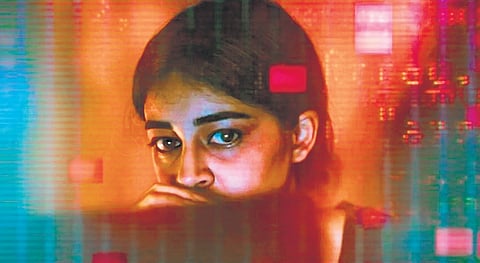

Director Vikramaditya Motwane has a penchant for the usual. He taps into everyday, innocuous situations to make films that expose the oft-ignored but equally relevant tale. He did it with Udaan by examining a complicated father-son relationship. He did it again with Sacred Games, laying bare the vulnerablity of a cop and the complexity of evil. He showed the human side of a thief in Lootera. Now, he has stayed true to form with his new OTT film, CTRL, which looks at how technology is gradually transforming from a tool to a nemesis. Excerpts from an interview:
Your latest show on Netflix, CTRL, explores the dark side of technology. How did the idea originate?
The intention behind the thriller is to show how we have been living our lives lately. And, doing it through the medium of a laptop seemed like an interesting way of telling the story. I wanted to show how we end up getting controlled by the very things we thought we had control over. Of course, when we were writing it in 2020, it felt futuristic. We didn’t realise that developments in AI would be this fast. So now, when the show is releasing, it has become a sort of documentary. There is a lot of talk about
why people share personal content online; whether it is simply for the joy of sharing, or if they do it for profit. CTRL is a way of bringing that conversation to the forefront, but in the guise of a fun, exciting thriller.
CTRL is touted to be (actor) Ananya Panday’s best performance so far. Was she your first choice?
The reason I cast Ananya was because I loved her in Gehraiyaan. She was phenomenal. The discussion about nepo-kids always getting a chance is a usual topic of discussion, and it is wonderful when such assumptions are broken.
I think that’s what happened with Gehraiyaan. I was impressed with her, and when I started working on CTRL, I called Shakun Batra (Gehraiyaan director). He had only the nicest things to say about Ananya. On set too, I discovered that she wasn’t just hardworking, but also got the pulse of her character on point. She was nervous, too, which is a great thing because she wants to prove herself.

The recent writers’ strike in Hollywood was also the first so-called workplace battle between humans and AI. How real do you think is the threat?
A lot of us writers laugh at the stuff Chat GPT throws up when you give prompts for a story around a certain idea. Though we are laughing at the average and poor results, once enough learning is done, and we can prompt it in the right way, AI can not only help make things better, but end up creating them. There’s already a situation where we don’t know how much of the photographs we see is the work of AI. The rate at which technology is developing, AI is going to be quite a game-changer. The question here is how do we control it? How do we put effective gates to be able to make sure it is not barging through all at once?
Several old Bollywood films have been re-released in theatres recently. The reason, according to social media chatter, is the lack of good original content.
The industry has been going through re-calibration. We’ve seen in the last two years that being a star is important, and having one in your film will take it to the next level, but only if the film is exciting. You can no longer get an opening for a film that is just not going to be good, no matter who the star is.
Viewers incline towards genres such as action, comedy, horror-comedy, and movies like Crew, which is a borderline heist films. I think re-calibration is a good thing. In the next couple of years, you will see Bollywood refining itself. There is also some diversity; you end up watching a Stree and Animal. Both are such different films, and yet have done so much business. There can never be a one-size-fits-all when it comes to the movies.
From Udaan to CTRL, you complete 14 years in the industry. Has your process changed over the years?
I am the kid who grew up watching a lot of James Cameron films like The Terminator, Die Hard and Back to the Future. Then, in the ’90s, came Quentin Tarantino and Danny Boyle. But, we could never make those kinds of films in India at the time. We were always told that we can’t do sci-fi or big action. That has changed. Now is a good time to make the kind of movies I have believed in.