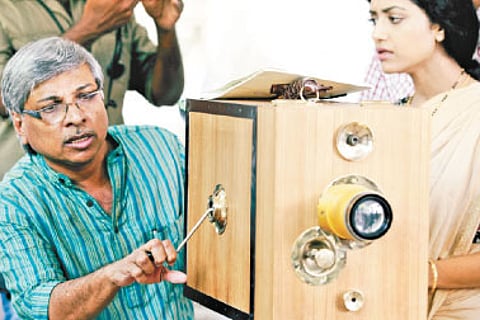

J C Daniel, who belonged to the erstwhile Travancore state, had made a silent film, Vigathakumaran (Lost Child) 75 years ago. He had written, edited and produced the film, apart from doing a prominent role. Daniel had to sell most of his belongings to make the film. But the screening in Thiruvananthapuram was disrupted by the castiest forces of those times because a Dalit woman had portrayed the heroine, who was an upper caste woman. Unfortunately, the print was destroyed because Harris, Daniel’s youngest son, burned it as part of a childhood prank. Daniel, who was once a landlord, died in penury at Agastheeswaram in Tamil Nadu.
It was journalist Chelangad Gopalakrishnan who rescued Daniel from oblivion by writing a book, J C Danielinte Jeevitha Katha (The Life Story of J C Daniel).
Nearly five years ago, veteran director Kamal read a novel about Rosy, the first heroine in Malayalam. It was titled Nashtanayika, written by journalist Vinu Abraham. “Then I came across the biography of Daniel by Gopalakrishnan,” says Kamal. “Later, Vinu told me that both the books could form the material for a film.”
So, Kamal decided to make a film. “Some people asked me why I was taking the risk of making a film on a period subject,” he says. “But I was convinced that even if it was not history, the story of a fallen hero who died as a nobody, all for the love for cinema, would be interesting.”
It took almost one-and-a-half years for Kamal to convert the concept into reality. Much homework had to be done on the dialect of the era. “I was not fluent with the language spoken in southern Kerala during those days,” says Kamal. “So I sat with poet V Madhusoodanan Nair who recreated the dialogues to suit the period.”
Prithvi Raj and Mamta played Daniel and his wife Janet, noted actor Sreenivasan played Chelangad Gopalakrishan, while a newcomer, Chandni, took the role of Rosy.
Veteran actors Nedumudi Venu, Siddique, and Thalaivasal Vijay appear in significant cameos. “Moreover, the presence of Nandhu Madhav as Dadasaheb Phalke is notable as he had enacted the same role in Harishchandrachi Factory (a Marathi film which highlighted the struggle of Phalke to make Raja Harishchandra in 1913),” says the director.
Though primarily seen as a tribute to the ‘father of Malayalam cinema’, who can also be regarded as a social revolutionary, the film also depicts the life of a few people who dedicated their life to cinema and made tremendous sacrifices for the love of movies, in a society steeped in casteist and feudal tendencies.
“I chose the title, Celluloid, as it is also fading with time, just as Daniel and Rosy did,” says Kamal. “It is an irony that those who make history are displaced from the annals of history.”
The film, which released recently, has been doing well at the box-office. It also won seven awards in the 2012 state film awards.
