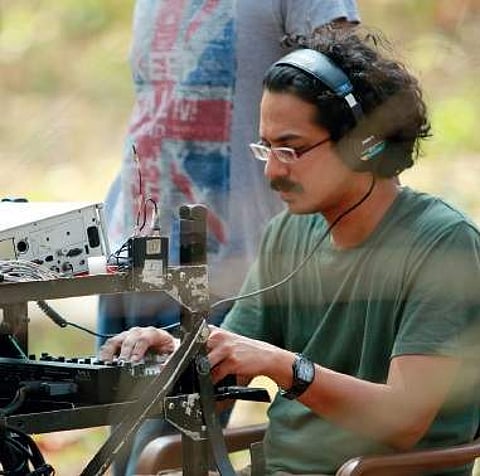

The irony about sound in films is that you notice it only when it is absent. The screeching tyres, cooing birds and ruffling leaves may prima facie seem insignificant but does a lot in building the mood whilst establishing a scene.

Now, cut to films sans all the ‘drama’. Or, think Dr Biju brand of cinema known for their realistic content. Whether it be the bustling streets in Perariyathavar, the violent waves in Akashathinte Niram or the eerie silence in dark jungles of his recent Kadu Pookunna Neram, the sounds in Dr Biju movies are narrators by themselves, courtesy the directors insistence of employing sync sound (sound recorded at the time of the filming of movies) for his movies.
And, if sounds speak a lot here, it shows the effort of the trio - Jayadevan Chakkadath, Bobby John, and Pramod J Thomas - who have been working with the award-winning film maker for his last five films in the sound department, starting from Veetilekulla Vazhi in 2011.
Though sync sound system has caught up in other industries, in Malayalam it is confined to a few directors and Dr Biju is one who insist on real sounds for his movies.
The sync sound
The cycle of synchronized sound recording begins at the hands of Jayadevan Chakkadath who accompanies the crew to the locations, where the sounds are recorded using sensitive microphones.
“How much ever efficient the studio recordings are, it never gives the perfection of sync sound. Though there are many challenges, sync sound gives the movies a sense of completion. For instance, on the location of Perariyathavar, which was shot at the busy Kollam town, there was too much noise with people crowding to watch the shoot. But, this apart recording a sound on the spot always has its benefits,” says Jayadevan who is based in Bangalore.
He says that unknown to the majority, the tonality of sounds vary. “During the shoot of Akashathinte Niram (2012), the sound of waves varied with high tide and low tide. Though it may be sound inconsequential, onscreen it produces a huge jerk. Such factors have to be taken care of,” says Jayadevan who last worked with Dr Biju in Kaadu Pookunna Neram (2016).
The recorded sound then reaches the hands of Bobby John of Mumbai-based Prathiba Studio, who does the post production of sound. “My job mainly involves editing the sound that was recorded at the location. Basically, it is about editing the unwanted sounds and noise, besides correcting the flaws. In the recent movie Kaadu Pookunna Neram (2012) shot at a jungle in Pathanamthitta, most scenes had the chirping of a cricket which varies every time. This flaw was removed on the studio. Same with the dialgoues and the background voices that accompany it,” says Vazhakkulam-based Bobby.
Then, Pramod J Thomas comes into the picture. He is the one who handles the sound mixing department; who with creativity mixes the edited sounds with dialogues and effects for viewing in exhibition format.
“Dr Biju’s movies are realistic in everything from the content to the sound. It is only about the basic story telling. Hence, the sound should also be realistic. There is no space for forced music here,” says Pramod.
And, the trio says they are quite sure of the directors demand after having worked with him for years.
“We know what his demands are and he makes a few suggestions. But, over the years, we know the working style of the others that makes our job easy,” says Jayadevan Chekkadath.