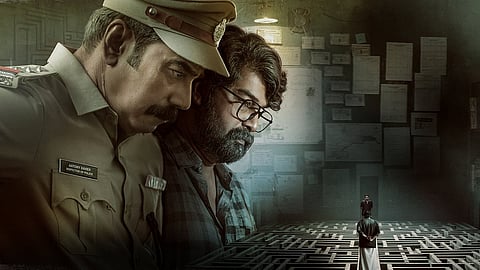

Every time Jeethu Joseph ventures into crime, he is weighed down by the burden of his own legacy. Drishyam and Memories have set benchmarks that are hard to escape. Yet, to his credit, Jeethu has continued to explore new avenues within the genre. 12th Man was a legit whodunnit, Kooman an intriguing character study of a criminal mind, and Neru a laborious exploration of the legal process behind proving a crime. With Valathu Vashathe Kallan, he once again returns to familiar territory — this time examining parenting and its role in shaping a criminal. It’s a potent idea, no doubt. Unfortunately, the film rarely sustains the level of engagement required to do it justice.
Cast: Biju Menon, Joju George, Vyshnavi Raj, KR Gokul, Leona Lishoy
Director: Jeethu Joseph
Visually and tonally, Valathu Vashathe Kallan often evokes Jeethu's own Memories with its brooding atmosphere, the generous dose of Christian references, and a police investigation structured like a puzzle game. But where Memories thrived on unpredictability, this film falters with its impractical plotting and lack of surprise. Jeethu, known for his commitment to grounded storytelling, abandons realism here, particularly in the second half, where a grief-stricken, revenge-driven father begins orchestrating his plan like some video game. After patiently setting up the characters and conflicts, the film steadily loses steam once it becomes overly fixated on clues and crosswords.
Both Jeethu and writer Dinu Thomas Eelan have previously explored parenting in films like Koodasha, Mummy & Me, My Boss, and Drishyam. Here, since parenting is the central theme, the characters are sketched in broad strokes. Antony Xavier (Biju Menon) is an abusive, aggressive father whose toxic upbringing leaves deep scars on his son, while Samuel (Joju George) is a supportive, progressive parent who encourages and deeply admires his activist daughter. Of the two, Antony is by far the more compelling figure — a corrupt officer and an emotionally distant father, desperate for redemption. Biju Menon delivers a sincere performance, lending depth that the writing often withholds. Joju George is convincing as a doting father and a supposed genius, whose high IQ is repeatedly underlined in dialogue. However, despite the promise, their much-hyped battle of wits never truly takes off, reducing what should have been a tense psychological duel into generic mind games.
Beyond these two performances, very little registers. KR Gokul, who made a strong impression in Aadujeevitham, struggles here from the outset, failing to convincingly convey the trauma and emotional turmoil central to his character. Several characters appear briefly and vanish without consequence, like Niranjana Anoop’s Veena. Her relationship with an accused is mentioned in passing and then abruptly abandoned. The writing also underestimates the audience, relying heavily on exposition. Samuel is introduced as a tech expert capable of recovering lost data from a hard disk; in another scene, his daughter explicitly calls him a “brilliant hacker”. By now, you know these skills will be conveniently recycled later.
Characters like Antony’s assistants, Johnny (Irshad) and Vidhya (Leona Lishoy), exist purely to relay information to the audience. The second half aims to function as a race-against-time thriller, with the police scrambling to save a life. Yet, even during these supposedly tense moments, officers are reduced to asking questions like “ini nammal enthu cheyyum?”, “adutha clue enthayirikkum?”, and “evide aayirikkum location?”, which they are meant to answer themselves. It is also hard to imagine why an entire police station would risk their careers to protect a superior who is neither particularly likeable nor morally upright.
Valathu Vashathe Kallan’s most compelling element remains the volatile relationship between a toxic father and his son, how such an upbringing can nurture criminal tendencies, and the eventual repentance. Everything else, including the elaborate puzzle-solving, feels largely forgettable.
