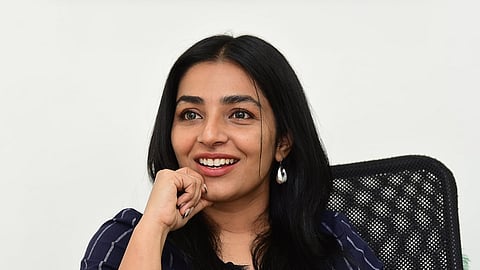

From the moment she won hearts through her State Award-winning performance as Elizabeth in her debut film Anuraga Karikkin Vellam, it was clear that Rajisha Vijayan possessed a rare ease in front of the camera.
She later returned with another memorable turn in June, capturing the fleeting uncertainties of teenage life with unusual warmth. A decade later, that journey has unfolded at an unhurried pace, with most of the roles chosen with care rather than urgency.
Her latest role in Krishand’s science fiction comedy Masthishka Maranam, set in the Kochi of 2046, pushes her into bold new territory unlike anything she’s played till now. As the enigmatic superstar Frida Soman, Rajisha anchors a film that examines voyeurism and the commodification of a woman’s body through a futuristic lens.
Excerpts
What was your childhood like?
I studied in seven schools. Due to my father’s transfers, we moved frequently, through Punjab, Tripura, Delhi, Meerut, Pune, Kashmir, West Bengal, and back home to Kerala. That helped me a lot. I learnt how to adapt and pick up languages quickly. My love for travelling and food comes from those early years.
Who were your favourite actors while growing up?
I adored Shobana, Urvashi, Kalpana, Sukumari, KPAC Lalitha, Philomina, Karthika, Sumalatha, Madhavi…. and then came Manju Warrier, Samyuktha Varma… then, Kavya, Navya, Meera, Bhavana.
We always had a set of strong actresses with strong characters written for them, from bubbly and funny to serious. Beyond Malayalam, Smita Patil and Tabu. Actresses then had this charm, and they all looked so unique. I have also had an extra love for any actress who could do humour. Making others laugh is not easy.
Is comedy your favourite genre?
I am always a bit partial towards comedy and romance. And the genre I never watch is horror. I am petrified by ghosts (laughs).
You studied journalism, and then became a VJ. At that time, did you aspire to become an actor?
I have wanted to be an actor for as long as I can remember. As a child, I used to watch films and then act in front of the mirror. But in my mind, I always thought it would never actually happen. No one in my family was connected to the film industry. Everyone prioritised academics. Moreover, I believed that cinema would not be possible for me as I looked a certain way. I never went for auditions.
Later, while working as an anchor, opportunities began to trickle in. Nayanthara, Nazriya and Parvathy were coming into films from television. Something similar started to seem possible. About a year later, Anuraga Karikkin Vellam happened. So, if you ask whether I desired it, yes, I desired it deeply. But I did not struggle, or chase opportunities. I have been quite lucky. That said, it is not sheer accident. I suppose my journey sits somewhere in the grey area.
Were there auditions for your first film?
When I look back at that now, I sometimes feel like I should return my State Award (laughs). (Khalid) Rahman, Nissam (Basheer) and Jimshi (Khalid) made me do something in the name of an audition. Honestly, my performance was quite bad. Even today, I have no idea what they saw in me. Once the shoot began, everything started falling into place.
Did winning the State Award for the debut performance feel empowering, or did it add pressure?
That was a shock! My mother actually asked me, “Are you sure they have not got the name wrong?” I genuinely thought people might boo me. My only prayer was that the character should be accepted. When you do not even know whether you actually know how to act, I was simply happy that I did not get insulted. So at a moment like that, receiving an award felt like a light-bulb moment. I thought, ‘Maybe this is something I can actually do.’ There was no pressure because I did not even know whether I would get another film (laughs).
I really felt pressure for the first time during the shoot of June. That was a film I had to shoulder to some extent. The project had been rejected by 16 producers, and almost everyone involved was a newcomer. But somewhere deep down, we had confidence in the material.
How supportive has your family been?
I feel like I have the most encouraging parents in the world. First, I told them I wanted to study medicine, then I studied Journalism, then decided to become a VJ, and then became an actor. With every shift, they simply said, ‘If this feels right for you, go ahead.’ When you have parents like that, you feel an added pressure not just to prove yourself right but to prove that their trust in you was justified.
How has your selection of films evolved over the years?
After Anuraga Karikkin Vellam, almost 98 per cent of the films offered to me were similar to that character. Even during narrations, they would mention the drunken and crying scenes because those had worked well. But, I wanted to do something different. I need to feel a spark while listening to a script, and think about whether I can contribute something meaningful, regardless of my screen time.
Have you ever taken up a project without fully knowing your character, simply out of trust in the filmmaker?
If I want to work with a filmmaker, I will go ahead because I know they will utilise me well. In the case of Bison, I was told the role was the sister’s character. Since I had worked with the director before, I knew how she would be positioned. Similarly, if someone like Amal Neerad calls, I would know it’s a project that I should work on. However, if it is a newcomer, I go through the script thoroughly.
How did you come on board for Kalamkaval?
It happened because of Mammookka. I kept asking him for a role until I finally got one (laughs). I casually asked him one day, and Mammookka mentioned he was doing something like this. I immediately said yes. Within an hour, Jithin (K Jose) arrived to narrate the script. He asked me which character I would choose. I was the first female actor to hear the story. I also want to share the screen with Mohanlal, Suresh Gopi… even if it is just for one shot.
How different is the work culture in other industries like Tamil or Telugu?
The main difference is in the budgets. When people in other industries hear the budget of a Malayalam film, they are often shocked. Sometimes our entire production budget might be equal to their caravan budget. The audience reception also varies. Tamil audiences are very expressive and immensely loving. Malayali audiences are more analytical and rooted. If they do not like something, they will openly criticise it. Telugu audiences treat cinema as a celebration. In Hindi, the system feels more corporate and structured.
What was your reaction when Krishand first pitched Frida Soman’s role in Masthishka Maranam to you?
It was after watching my performances in Madhura Manohara Moham and Love that Krishand felt my comic timing would work well. I was just so excited! I did not even stop to think about whether I could pull it off. Women rarely get the opportunity to play such wild, uninhibited characters. I was plain lucky that Krishand decided to offer me the role. When you see something that exciting, you just jump in and grab it.
Why do you say it’s rare for female actors to get such roles?
Any actor has to be very lucky to get a character like this, and women find it even harder. That is the harsh reality. I was so happy when Lokah — it felt like a personal win. Similarly, after Masthishka Marnanam was released, my colleagues such as Nimisha, Aparna, Nilja, and Namitha sent messages about how it felt like their success. Supporting characters, too, are scarce for women now. This is not because of a lack of talent.
What were your impressions of Krishand’s script?
Processing Krishand as a person took longer than processing the script. We all have wild thoughts, don’t we? Imagination is open to all of us. But the confidence to take that imagination, turn it into a script, and execute it as a film without a big star in Malayalam — that is something else entirely. That kind of spunk genuinely shocked me.
How did you approach the ‘wild’ character?
It was scary. When the performance meter goes higher, things can easily go wrong. So I was nervous about getting the tone right. It is really about trusting your director, and Krishand has a lot of clarity. I did all the homework I could, but I was extremely tense. I did not sleep until the first day of the show.
Were there any dialogues you connected with?
The one about media people hounding actors even during funerals. I may have not said it out loud, but have always thought about it. I think when we lose a sense of accountability, we also lose empathy. One can ask: ‘When is your next project’ or ‘Oh, you don’t have any projects now, right?’’ The difference is something people need to learn.
Any personal similarity with the character?
Like Frida, I have also Googled myself (laughs). I could connect with her to a certain limit, but never felt that I am like her. I related to her as an actor, not because of the incidents that happen in her life.
How did you ensure Frida felt unique?
I did not want any of the mannerisms from June, Eli or even Raji from Bison to come out. Frida is a superstar from 2046. Half of my work was in body acting and looking the part. I was inspired by the likes of Meryl Streep in The Devil Wears Prada, Margot Robbie’s Harley Quinn, and Kate Winslet in Mare of Easttown. But I did not want to look like I was mimicking someone. Internalising the character was paramount.
There is a lot of talk about method acting in this film. What is your acting process like?
Method acting is when you live like the character throughout the day. I have not done anything like that. I like creating playlists for characters, writing letters to them, and putting in physical effort to be that person. I was one of those students who would remind teachers about the homework (laughs). Before the shot, I like to be in the character’s mood. I do not think that is called method acting. It is my kind of method, which might or might not work.
What was the brief you received from Krishand about the item song ‘Komala Thamara’ that made headlines?
Krishand did not have to brief me about the song; he only narrated the script to me. And anyone who listens to the narration of the script will not ask why we needed this song. It had a genuine purpose in the film. And I have the capacity to comprehend that. The song has an organic space there, and conceptually it made sense. Hence, I did not have to ask too many questions. There was no need for that. I chose not to speak much about it because I knew that once people watch the movie, they would understand its relevance.
The film raises the question of AI potentially replacing real actors...
It is definitely scary. But I do not think it is something we can stop. AI films will happen. However, when you use any AI tool, there is always something missing: originality and spontaneity. AI works by absorbing information and recombining it. Real newness comes from human imagination. I believe there will be a boom in live artforms when AI films become common. People will crave the real thing.
Masthishka Maranam is a direct critique of the male gaze and voyeuristic culture. Were there discussions on ensuring this does not come across as virtue signalling?
Messaging was never our intention. Cinema is a reflection of society. Although this film is set in 2046, a lot of things we see in it already exist. So, imagine what will happen at that time. We narrated all of it with humour, without intending to hurt anyone. If done right, films can affect people, but not influence. Cinema is not here to change people.
There has been a perception that there are not many takers for heroine-oriented films. What is your take?
I have never felt that a film is hero- or heroine-oriented. It is always filmmaker-oriented. The writing of the film is where the magic happens. More women characters can be written if the script demands that… you cannot force a female role just for the sake of it. This is not charity. Producers are spending their hard-earned money. Content is still king. The only advantage of stars is that you can pull in the crowd initially. We, however, saw content-driven films like Aattam and Eko become successful.
Do you think there is a dearth of romance films of late?
Absolutely. There is not much romance on screen. Especially after the pandemic, we are concentrating on emotions on one side of the spectrum. Which was the last really good romance film you watched? Mayaanadhi, perhaps? That came out almost 10 years ago. I do miss romance films.
You use social media minimally, even WhatsApp, even at a time when networking is considered vital…
I feel I am privileged enough to do that. With social media, it was a conscious effort. It was absorbing a lot of my time. Moreover, I understood how big corporations could influence one’s thoughts. There are positive aspects too. Social media has become a good space for people to showcase their talents. So I would not brand social media as good or bad. But minimal use is what works for me.
Do you reach out to directors for opportunities?
Of course! We can’t sit back and assume everything will come searching for us. In a corporate job, people update their CVs and send them out for better opportunities. There is nothing wrong with doing something similar in cinema as well. Many films actually happen because someone reached out.
Have you started shooting for Amal Neerad’s new film Bachelor Party D’eux?
Yes, we have started. He is also a friend. His knowledge is simply remarkable. The kind of films he watches and discusses opens up an entirely new world for me. Every time I talk to him about films, I learn something new.
Are you also looking at roles behind the camera?
So far, I have not done anything seriously in that direction. Maybe when I feel confident enough, I might try. I do like writing. I am trying, but at the moment, what I write is not even worth reading (laughs).
Your father served in the Army. Do the current global conflicts affect you personally?
It does affect me because the value of life is the same for everyone. During my childhood, whenever there was tension at the border, I remember sitting and hugging my father’s uniform and crying. Even if the person on the other side is considered the enemy, the emotions their family goes through are exactly the same. Nobody truly benefits from war.
What are your interests outside cinema?
I travel a lot. Now people think I am travelling full-time (laughs). Apart from that, I spend time at home with my dogs, watch a lot of films and series, read a little, write occasionally, and sleep well. I also enjoy exploring food, although, because of our profession, there are limitations.
This is your tenth year in the industry. How does it feel?
Honestly, if I were to die today, I would be the happiest person. I would be content. I am absolutely in love with the journey I have had, whether it was good, bad, or ugly. I got to play some wonderful characters, work with great filmmakers, act alongside actors I have admired, and meet a lot of fresh talent. I hope it continues this way.
You often speak about death...
My sense of humour is actually very dark (laughs). I feel death should be treated as something completely normal. If you are too scared of death, you will be too scared to live. But if you understand that the call can come at any time, the present moment becomes incredibly important. You start making the most of your time. My acceptance of death actually comes from my love for life.
(Team TNIE: Vivek Santhosh, Vignesh Madhu, Krishna PS, Supriya)
