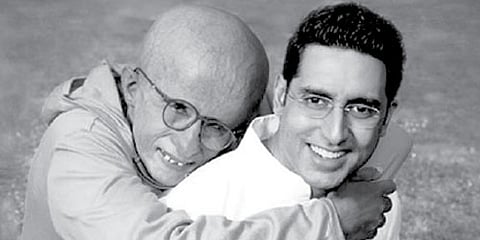

He has been the hero of millions and the reason why hundreds have entered the Indian film industry. But the projects of the last decade have hardly challenged or been respectful to the abundant talent and towering presence of Amitabh Bachchan. R Balki’s Auro, a 12-year-old boy with progeria disease, certainly does that. And Bachchan’s embracing of the character at the age of 67, convincing us completely of the child in the ageing body, is a fitting testimony to his legendary status.
In 2007, Balki presented 'Cheeni Kum', the Amitabh Bachchan-Tabu film I walked out of pre-interval. At no point in Paa do you feel like walking out. On the contrary, you are rooting for Auro, absorbed by the tenderness of the tale and transported into a personal story by the actors, camerawork, locations and Ilayaraja’s music.
We meet Auro in the first sequence in the film — a popular and bright boy who stands out for one reason alone, his appearance.
According to Wikipedia, progeria is “an extremely rare, severe, genetic condition wherein symptoms resembling aspects of aging are manifested at an early age... Those born with progeria typically live about 13 years...” Almost instantly you are on his side, so endearing is his character, so honest is the portrayal by Bachchan.
We soon learn that he is raised by his gynecologist mother Vidya (Vidya Balan) and grandmother (Arundhati Nag). The trio lives a happy and comfortable life in Lucknow but the atmosphere is never without tension about Auro’s health. His gang of friends in school is aware of his limitations and is constantly looking out for him. His teachers are supportive and accommodating. But it’s not always been so easy for Auro to lead a normal life, as we discover over time.
Two critical plot points emphasise the importance of fate in guiding one’s destiny.
The first is Vidya’s relationship as a student that leads to the birth of Auro and the second is a meeting between Auro and idealistic politician Amol (Abhishek Bachchan). While the first is dealt with mostly through a song montage, the second leads to the first hiccup in the script — a long-drawn out section painting Amol to be a righteous and selfless politician including an unnecessary tirade against the media. Far too much time and energy is spent building up his character, showing an ambitious adversary and commenting on corruption, hypocrisy and the media’s myopia.
The script slackens in the first half due to this and in the second again when the filmmaker struggles to establish a bond between father and son, leading to a protracted climax.
However, the distractions, side-plots and flaccid moments are compensated for by characters that are never self-pitying, and by the absence of melodrama. Single mother Vidya is not shown regretting her life-changing decision.
Auro is not a normal child but is treated like a mature 12-year-old who may make potty references and be shy of girls but is smart enough to accept his reality.
The dialogue is snappy and realistic, and barring the sermonising and hard-tobelieve idealistic preaching from the ambitious and focused Amol, the mood is generally light. A hanky could be handy, but Paa is peppered with enough one-liners and cheeky repartee initiated by the 12-year-old to keep you smiling and involved.
Vidya Balan is perfectly cast as the practical and doting mother who has spent 12 years preparing for the inevitable. Paa really is a mother-son story rather than a father-son story as the publicity suggests with Vidya at the heart of the movie. Abhishek Bachchan delivers a controlled, convincing performance as the MP who finds himself inexplicably drawn to this special child.
Paresh Rawal and Arundhati Nag bring requisite maturity as the compassionate parents.
Jaya Bachchan as the narrator on the credits adds a warm and welcoming touch and don’t miss Auro (Bachchan) singing over the end credits. In fact, Bachchan meticulously maintains a childish voice throughout, changes posture, often does not know what to do with his hands, chats to his giant gorilla toy and never lets you feel sorry for him.
Kudos to the make up team that, with the assistance of costumes and P C Sreeram’s wonderful camerawork, transformed Bachchan into Auro. You forget the actor and see only Auro, for which one must give credit to the hard work and professionalism of Amitabh Bachchan. For a masterful performance and an enjoyable film, Paa is a mustwatch.
Maybe now all those with scripts for Amitabh Bachchan will throw out the genies, bad wigs and bring into the light characters worthy of his experience and abilities.
uditaj@gmail.com