
Those who believe that crime doesn't pay would do well to consider John Dillinger. He may have died in 1934, but this serial bank robber and jail breaker, adored as a modern-day Robin Hood by some, dubbed Public Enemy Number One by the police, has never been forgotten.
Countless biographers have mythologised or counter-mythologised him. Punk bands and reggae musicians, drawn to the romance of the "live fast, die young" ethos by which he lived have named themselves after him. Over the decades, film makers have regularly been tempted to make biopics about him.
Battle?of the blockbustersDillinger has become something of an industry. His good looks, snappy fashion-sense and his outlaw reputation give him a brand cachet denied to other Depression-era thieves and pistol-wielders. However, in Public Enemies, Michael Mann goes out of his way to try and avoid portraying him as a period-piece master criminal.
As we might expect from one of modern cinema's most brilliant action-thriller directors, this film, shot, like Collateral (2004) and Miami Vice (2006), in high-definition digital video, has a wired intensity that ensures this is far from being a cosy, matinee gangster flick.
Written by Mann, Ronan Bennett and Ann Biderman, from a 2004 biography by Bryan Burrough, Public Enemies begins with Dillinger (Johnny Depp) striding into a Midwestern jail where, with the help of a long-term associate, he disarms the guards and frees a number of prisoners.
It should be a triumphant moment in which the escapees whoop and holler, but one of the prisoners is wounded and ends up being dragged alongside the getaway car.
Dillinger, who has been holding on to his arm, lets go. Then, he turns to a man sitting on his other side, and pushes him out. This, it's very clear, is going to be a movie heavy with feel-bad mood.
Who is Dillinger? He is given very little back story. Nothing that happened in the past is of any consequence to him. Where people come from, he says at one point, doesn't matter; what's important is where they're going. Depp plays him as a shiny-skinned, clean-eared, tersely-spoken man-machine defined by and dedicated to his desires.
"What do you want?" asks Billie Frechette (Marion Cotillard) a night-club hat-check girl whom he decides will be his girlfriend. "Everything. Right now." On another occasion, he declares, with almost comic functionalism: "I'm John Dillinger. I rob banks." Indeed, in and out of banks he storms, wreaking what some men and women at the time regarded as payback for the damage capitalism had inflicted on America. A radio newscaster is heard, in the background to one scene, talking about the "Red Menace" represented by insurgent trade unions.
J. Edgar Hoover (Billy Crudup), who in later years would expend so much energy on rooting out and attacking Communists, is shown struggling to come up with crime-fighting techniques that he would later develop and refine at the FBI.
Crudup plays him, with commendable subtlety, as a jowly fool blinded by systems and technologies. It takes the arrival of top agent Melvin Purvis (Christian Bale), a man-hunter with a drive and violent efficiency to rival that of Dillinger, to give the law-enforcement authorities even a chance of nailing their target. Even then, as a number of scenes depict with startling and close-up clarity, they lose a number of officers along the way.
Bale, almost as gruff and taciturn as he was when pursuing Heath Ledger's Joker in The Dark Knight (2008), doesn't bring much to the drama other than sullen endeavour. That's not necessarily a disaster; after all, it's Depp who's going to be supplying the charisma, right?
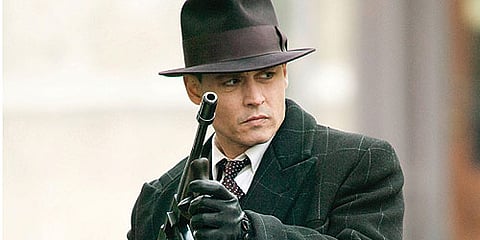
Actually, no. Depp looks great in his Fedora and long coats. He's not bad at pulling out a tommy gun and spraying bullets at police agents, either. But these are costume changes, gestures and poses, little more than wan impersonations. He's bloodless, a vacuum at the centre of the film, unwilling or unable to risk any kind of emotional investment in or make a stab at interpreting his character.
The only scenes he lights up are those involving celebrity: when, about to go back to jail, Dillinger poses for paparazzi; a trip to the cinema where a newsreel urges audience members to tell the police if they spot him; an excellent, dream-like episode in which, with nearly all city cops out looking for him, he walks into a station and wanders through an office plastered with his mug shots.
For the most part, though, we're left longing for a fraction of the heft and muscle that Jimmy Cagney or Edward G. Robinson brought to such roles. We may also wonder: how has it come to pass that so blank a performer is regarded as star material?
Much better is the wonderful Marion Cotillard, last seen in Piaf (2007), who pulls off the difficult trick of being both needy and confident at the same time.
Her hunger – for excitement, protection, the certainty that she finds in Dillinger – supplies the emotion that the movie, which in its second half veers into a technically superior and visually striking police procedural, all too often lacks.
It would be easy to rave about Mann's genius for staging shoot-outs, and for filming at night, and for the gifted cinematographers and sound designers he hires. But, rightly or wrongly, his many fans have come to take those talents for granted.
What's dismaying about Public Enemies, over and beyond the unintelligibility of much of the dialogue and the sliminess of its digital sheen, is that it has no sense of why it's been made. Its stabs at contemporary resonance – Hoover calls his campaign "the United States' first war on crime" – are half-hearted.
It's void of emotion, too. As a result, it's the first Mann film I've ever watched in which I found myself checking my watch.