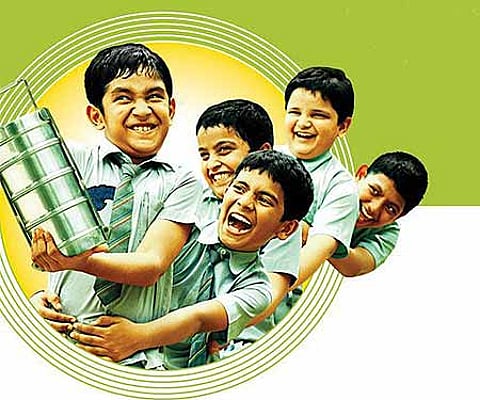

'Stanley Ka Dabba ' (Hindi)
Director: Amole Gupte
Cast: Partho, Amole Gupte, Divya Dutta, Rahul Singh
Scholastic endeavour, for the non-home schooled, never been to daycare majority, is the commencement of the process of being weaned away from one’s parents. It is a child’s first foray alone into a community that isn’t parentally controlled. However, the process is gradual – home and school do not exist in isolation. Elements of one constantly find their way into the other.
Schoolbags filled with prescribed textbooks and homework assignments are the school’s interlopers. They hover over children during short-lived evenings and weekends as harbingers of responsibilities and pressures that are to come. The agents of home, lunch bags and water bottles, are the reassuring presence in our crowded school benches. Our lunchboxes are metaphors for the advantages and capabilities that home and chance provide us.
Amole Gupte’s ‘Stanley ka Dabba’ is founded on this analogy but does not rest with simply presenting it for consumption. One of its simple, yet telling images, is that of lunchboxes resting on a wooden platform in the classroom of IV-F in Mumbai’s Holy Family high school.
Amidst a jumbled pile of plastic that resembles the shanties of Rio de Janeiro stands tall, leaning tower of metal. This is the lunch dabba of Aman, resident food philanthropist of the class and friend of our intrepid protagonist Stanley (played by a precociously cute Partho).
When Stanley’s friends realize that he is without his own dabba, they decide to pool their resources to ensure he does not go hungry. However, Aman’s multistory buffet has caught the attention of the gluttonous Hindi teacher Babubhai Verma, played by Amole Gupte. Fondly termed Khadoos by his students, the teacher is not below imposing his authority to ensure that a student and his lunch are soon parted.
The endearing group of friends manages to feed Stanley for a few days by serving up a few white lies to Mr Verma, but they eventually get caught. He retaliates in a characteristically petulant manner, emphasizing what a song in the film suggests - that a hurt child, sans lunchbox, resides within him as well. It is, therefore, a slight disappointment when the pain and shame he carries remains unresolved.
‘Stanley ka Dabba’ would like us to view its children as unsullied, instinctive beings. There are no deserved punishments, only deserving accolades - usually handed down by the cloyingly affectionate Miss.Rosy played by Divya Dutta. She seems the sole spot of sunshine, a counterpoint to the stentorian south Indian science teacher. But even the most empathetic teachers seem to turn be blind to the root of Stanley’s issues. Apart from a minor rectus-sinister altercation, it is Stanley’s cohorts who seem to intuit his issues. It is an unconditional friendship that even shows the good sense not to dig too deep and disturb the false framework that Stanley has constructed.
The absence of a lunchbox is not the sole indicator that all is not well with Stanley. In fact we need look no further than the soiled uniform or the safety pin that holds his pocket in place to sense the lack of parental presence. Stanley is undoubtedly an outlier. He consistently arrives before the rest of his class to finish his homework and peers longingly through holes in the wall.
These indicators are more than sufficient to evoke a lump in one’s throat when the child is unfairly marginalized because we are flush with evidence that it is not entirely his fault. So when the explanation finally arrives it seems almost inconsequential. Having entrenched us so well in the cadences of a school day, the film is at a loss whenever it walks to a different beat.
Ironically, ‘Stanley ka Dabba’ is a film that is most at home within the classroom.