
In the growing list of cinematographers-turned-directors is Laxman Kumar, who has wielded the camera for films like ‘Vennila Kabaddi Kuzhu’ and ‘Thillu Mullu’. In ‘Masala Padam’ Laxman dons the additonal hat of director- co-producer. And for his debut theme ,its the Indian Film industry or rather the Tamil film industry and it’s unique blend of the multi-genre style, at times derisively dismissed as ‘masala entertainment’ that he has tried to explore. The director seems to have understood his theme well enough, as he goes about smartly crafting a tale that though using cliches camouflages it in a different flavour.

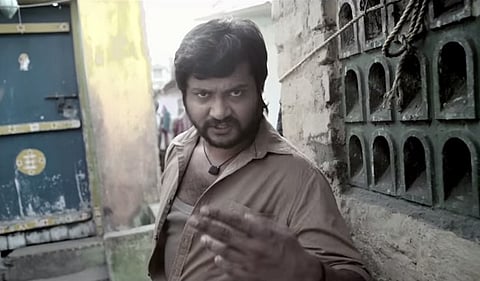
In a society which is multi -structured and audiences clearly demarcated as A,B and C center audiences, a blend of varied emotions that would satisfy all sections is a need he opines. And that Masala films with its hero-centric themes and larger than life protagonists are here to stay. It takes a dig at instant reviewing and online comments of bloggers who tear a film, sending producers into a frenzy. It’s an interesting opening. Where flashed on screen are scenes from films since the black and white era to the current ones, and the heroes who dominated them. Karthik a short film maker and a blog-writer (Somayajalu), slams a film that has just hit theaters. Film makers have been insulting audience intelligence feeding them with nonsensical entertainment he opines. It triggers a heated debate between Karthik and the producer (Venkatraman), the latter challenging the former to make a film that would satisfy viewers of all centers. The debate, and the common man’s take on films have some pithy dialogue, the director balancing both viewpoints. Karthik and team accept the challenge, and to gather matter for their script, select three men from different social strata, to have an idea of their take on cinema. Diya a photo journalist roped in to play the female lead, is given the responsibility of getting a first-hand perspective of their likes. It’s what happens after that. The director smartly moves his narrative and convincingly puts forth his view. The actors have been well cast, the director playing on their strong points. Shiva’s penchant for rendering one-liners with a deadpan face, perfectly sits on the character of Mani, a cheerful middle class guy representing the ‘B’ center; Simha’s intensity of expressions is capitalised on for the character of the angst driven brooding rowdy Amudhan who doesn’t hesitate to kill a cop in broad daylight; and debutant Gaurav with a pleasant screen presence suits the character of the rich spoilt brat Krish, representing the ‘A’ center here. Lakshmi’s Diya is charming ,the actress bringing out well the dilemna of the character when she realises that what was once just a ‘project’ for her, had been reality for the three men she had befriended. Some relevant points are made here. Like when Diya says that every human has two faces, one the ‘social face’, the other the ‘personal face’. And that it’s circumstances that makes a man what he is.
One has to hand it to the debutant director. Recycling happenings and events that have been the staple fare of innumerable ‘masala’ films, Laxman has managed to showcase them from a refreshing perspective and backdrop, lending it a feel of novelty and freshness.
It’s more a tribute to Tamil cinema and its celluloid heroes, whose magic is all pervasive, catapulting many to dizzying heights of power and fame in other fields. A quirky but lovable take on the ‘masala’ genre, you wouldn’t regret watching this film.