
Blending successfully the off-beat and commercial, Bala's films were aesthetic and entertaining. They turned the fortunes of it’s heroes Vikram and Surya, and earned the director iconic status. And now after a three year long wait comes the director's fourth venture 'Naan Kadavul'. But i's the film worth all the wait and hype? Not quite. For though good in parts and warranting a watch, it fails to match the standard the director has set for himself.
Plot
The movie opens in Kasi where a repentant ,guilt-ridden father goes in search of his son Rudran, to fetch him home. He had left the boy in an Ashram fourteen years back, following an astrologer's prediction, that the boy’s presence would spell doom for the family. Rudran leading the life of an Aghori , a sadhu disconnected from the world around him, on the advice of his guru reluctantly accompanies his father to his village. Around the place is the den of the ruthless dreaded Thandavan, the leader of an organised begging racket. It wouldn't be long before Rudran and Thandavan have a violent showdown.
Script and treatment
The film's opening is interesting, the backdrop of Kasi forming a novel ambience. Rudran's dramatic introduction and his father finding his son an Aghori disheveled and alienated from him, indicates problems to come when Rudran returned home. But this doesn’t happen. For the director barely touches on the emotional complexities, brushing past the scenes where Rudran re-unites with his new found family, and his pleading tearful mother.
The narration picks up speed again with the introduction of the ruthless Thandavan (impressive job by veteran stunt fighter Rajendran), and the cold blooded way he runs his buiness. One waits for the inevitable clash to happen when Rudran would finally encounter Thandavan. The clash does come, but it’s not as volatile as you would have anticipated, the fight reminding you of the final one ino Pithamagan.
If the scenes at Kasi had a superficial treatment and a stagey setting,the scenes Bala has crafted painstakingly and meticulously are the ones involving Thandavan and his beggar squad. Abnormal humans of all hues,twisted and deformed bodies,midgets and transvestites, some of them resigned to their fate,few others a cheerful lot finding humour in the midst of their dreary existence. Watching them at times makes you wince in pain at their lowly existence and inhuman exploitation. Hand it to Bala, he has squeezed out the maximum emotional -punch from these scenes. Which he didn’t bother to explore in the Rudran-family scenario.
But the camera closes in on the deformities a bit too often, lingering over them . Like in the scene where Thandavan tries to trade the blind beggar Amsa (Pooja) to a ‘wealthy’ beggar with a horrifying disfigured face, the camera lingering on it a bit too long for comfort. Done to death is the lengthy scene at the police station where a look-alikes dress and mimic top heroes. The scene at the court too, where Rudran is tried for murder and let free, is more of a mockery. A more coherent script and consistency in the narration would have helped.
A key strength is Illaiyaraja’s background score, which fuels the narration, and fills in the gaps where the punch is lacking.
The actors
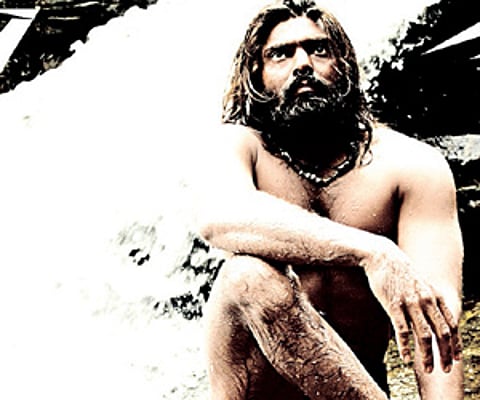
For Arya and Pooja, two actors known for their urban glamour-roles,it’s a total make-over, and an opportunity to experiment with off-beat characters. But unfortunately, what comes across in these roles is more the physical appearance, the make-up, costumes and postures.Particularly in the case of Rudran. We are introduced to Ruidran doing shirshasana,the camera circling around him catching him long in the lose. And then it's Rudran sitting with ash-smeared body and smoking hashish; or Rudran walking with long strides in stages of dress and undress; Rudran sitting around muttering some slogans; and his refrain of Aham Brahmasmi; and the character getting lost somewhere in all these postures and physicalities.We neither get any insight of Rudran's mind or his motivation,as these areas are never explored. Bala's scripts have been more character-centric ones, his protagonists psychologically challenged in some way, and fascinating .But here he falters in his etching and evolving of Rudran. Rudran may be Bala’s most exotic protagonist to-date. But it’s also the director’s most weakly defined one.
The film was in the making for about three years But when you see the final product you wonder if this was all the maker could manage to offer after the long time he spent on it. It’s different in concept no doubt, and good in parts. But it’s neither a great film, nor Bala’s best effort. If only the director had etched his screenplay more astutely.
expresso@epmltd.com