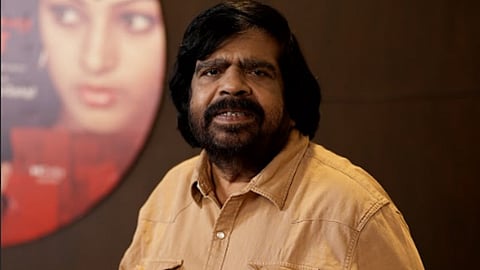

In 1983, a man who was known for his dialogues, his music, his directorial skills, and his empathetic way of showing emotions on screen, made his debut as a leading man in Uyirullavarai Usha. In an interaction with Cinema Express, the multi-hyphenate, T Rajendar, spoke about the film, which was re-released on February 13 for the Valentine's Day weekend.
Excerpts:
What set off the spark for Uyirullavarai Usha?
I wouldn't forget this no matter what. September 16, 1982, was the most unforgettable day of my life, a day which changed my life, my wedding day. The film I made immediately after marrying my Usha was Uyirullavarai Usha. So, even though people asked, 'Why this title?', I asked, 'Why not this title?'
But this film was life or death for us, because during the time of my marriage I was not a man of means. We didn't have much to go around. I didn't want the life of my new bride to go for a toss because had this film failed, the first comments would have been, 'The film failed because she came into your life.'
How was your journey in making this film?
The films I worked on like Oru Thalai Raagam (1980), Rail Payanangalil (1981), Vasantha Azhaippugal (1980), were hits. But Raagam Thedum Pallavi (1982) didn't perform as expected. When Nenjil Oru Raagam (1982) released, it ran for almost 100 days in the theatre. But the film was removed from the theatres before it could complete its 100 day run, because a producer had to give me a bonus if it did. That impacted me deeply. So when I distributed Raagam Thedum Pallavi (1982), I faced some losses. I wanted a win very badly, and that drove me to make Uyirullavarai Usha.
Do you cherish something from the sets of Uyirullavarai Usha?
There is an actor in the film, Ganga, who has been my friend since our days in Annamalai University. He was such a close friend, who asked for a chance to act, if and when I get into films. I couldn't keep that promise when I did Oru Thalai Raagam, or Vasantha Azhaippugal or Raagam Thedum Pallavi (1982), or Nenjil Oru Raagam (1982) because no other producer accepted him as a leading hero. But when I became the producer, I decided to cast him in Uyirullavarai Usha.
One way that Uyirullavarai Usha broke convention was through the introduction of your character, was it very intentional?
Of course, it was. These days, an introduction of the hero involves a combination of music and cinematography, which elevates the scene even before the hero mutters a sound. But before people could see my character of Chain Jayapal, I wanted to showcase his audacious nature. That is why there was an extensive dialogue, which was placed to increase the curiosity among audiences.
In the film, instead of giving extensive backstories for the other characters, you used small hints, like the title of a short story for Saritha's character...
Short stories had a big impact on me. When those stories were published it used to have accompanying illustrations, which fascinated me a lot. This even inspired me to create my own magazine, Usha. It was a matter of pride when a magazine was quoted as the source of a story.
So when I used the title of Vaazhavetti (estranged single woman), to hint at the story of Saritha's character, it came from a place of great fascination.
But the use of visuals in place of dialogues, more famously was used in the bus scene. How did that come about?
Every bus has that Pugai Pidikaadheergal (No smoking) sign, and in that scene I wanted to show, not tell. So, when the character in the bus continuously tries to hold her hand, I intentionally staged that scene so that Nalini blocked the sign partially, only showing Kai Pidikaadheergal (Don't grab hands). Even beyond the reception in Tamil Nadu, audiences in Andhra Pradesh were very appreciative of that scene, because their curiosity led them to hunt for the meaning of that scene. The film ran for two years in certain parts of Andhra Pradesh.
They always say that the strongest enemies turn into the greatest lovers. A trope which is recurring in your films. What was the reason behind adding it in Uyirullavarai Usha?
For a woman to like a man, there might be a thousand reasons, but for woman to not like him, there doesn't have to be a reason. So in Oru Thalai Raagam, throughout the film, even though Subhadra (Roopa) is not impressed by Raja (Shankar), it only takes a moment for her to realise her love. But unfortunately that yearing ends in a tragedy. Similarly in Uyirullavarai Usha, I wanted that kind of pining to be shown on screen, because I wanted to show that for love to succeed, you have to fight for it.
Beyond all the romantic storylines, the film was also politically charged, including lines that criticised politicians who were switching parties frequently...
When I was doing the film, I wasn't into politics, so I was sarcastic when saying those lines. There were lines about unemployment and about the unethical moves of the politicians, all of which I treated like water under the bridge.
Did you want to specifically make a film like this?
When I was studying MA History, I was a big fan of off-beat cinema. I loved watching commercial cinema, but I wanted my films to be unique. So the women in my films won't be glamorous. The men won't carry guns, nor will they be great fighters, because they are average men from hard backgrounds who work hard to seek their love. But because I had to make a commercial film, I turned the story into this. But Uyirullavarai Usha was a movie that changed my path.
