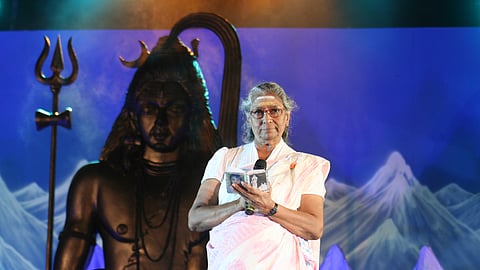

CHENNAI: Legendary playback singer S Janaki, fondly called the Nightingale of South India, passed away in Mysuru due to age-related health complications on Saturday. She was 88.
For more than six decades, Janaki was the voice not just of generations of actors, but also the most identifiable voice for years to come. While she was best known for her renditions of countless songs in South Indian languages, Janaki left an indelible mark in Hindi, Bengali and Odia, as well.
She began her singing career with the Tamil film, Vidhiyin Vilayattu (1957) at the age of 19. Although she retired from active playback singing in 2016, the 48,000 songs she sang in over 20 languages since the late 1950s will stand a testimony to her versatility.
The remarkable thing about her legacy is that every genre had its Janaki song. If you wanted to take the devotional route, you had the breathtaking Singara Velane Deva.
Soon enough, she became the voice of unadulterated romance, encompassing the age of ache and yearning with Senthoora Poove, which earned her the National Award. How could this same divine voice also define the tone of sensuality with Ponmeni Uruguthey?
And if you had any doubts about her versatility, you have the two amazing Sundari songs: Sundari Neeyum Sundaran Naanum and Sundari, Kannal oru seidhi...
And the singer, fondly called Janaki amma, also sang the two ‘Amma’ songs that would pacify the hearts of children longing for their mothers: Chinna Thaayaval from Thalapathy and Amma Amma from Velaiyilla Pattadhaari. Every era discovered a new Janaki.
She didn’t just adapt to changing musical landscapes but underscored them with her high-pitched yet soothing tone.
Janaki not only stayed in tune with times, she defined them
Whether it was the orchestration of MS Viswanathan, the genius of Ilaiyaraaja, the sophistication of KV Mahadevan, or the later collaborations with younger composers, Janaki didn’t catch up with the times but defined them with her voice. She constantly reinvented, but never let go of the aspect that defined her stellar career: Instant recognisability.
If it was one combination that left a profound impact on South Indian film music, it was S Janaki’s collaboration with Ilaiyaraaja. Together, they have produced songs that still rule the airwaves, and have outlived even the films they featured in.
Even her throaty whispers made hearts flutter, her full-throated yearning made them skip a beat, and it might not be too far-fetched to say that one of the most versatile instruments in Ilaiyaraaja’s arsenal was the malleable voice of S Janaki. The way Janaki made emotion and character the two pillars of her vocal range is stuff of history.
Playback singing is all about becoming the actor, and performing in a way you can’t discern the actor and the singer. Janaki was a maestro in that aspect. How could the same person be a cherubic villager, a high-handed woman, a grieving mother, a consoling partner, and even a child so effortlessly?
How could she embrace folk music and cabaret numbers the same way she delivered devotional songs and lullabies? How could she employ playful inflections and unadulterated performances without them affecting her identity? If you are Janaki and have mastery of vocal texture and dramatic interpretation, it might just be possible.
Every South Indian household carries memories tied to a Janaki song. Her voice travelled through transistor radios, cassette tapes, CDs, TV channels and streaming platforms. Generations of singers, from KS Chithra to Shreya Ghoshal and countless others, have acknowledged Janaki’s extraordinary command over expression.
Where there is such unbridled talent, recognition cannot be far behind. She won four National Film Awards for Best Female Playback Singer, apart from an extraordinary collection of State awards across TN, Kerala, AP and Karnataka. But she was also a fiercely protective artiste, who put herself above any awards that came her way.
In fact, in 2013, she politely declined the Padma Bhushan, stating that the recognition had come too late given her decades of contributions. S Janaki’s death draws curtains on one of Indian cinema’s richest musical chapters. But one can’t confine her legacy to statistics, the number of awards, or even the sheer number of songs.
There might be another gifted singer who traverses genres as if it were nobody’s business. There may be another pan-Indian talent that proves music is not bound by linguistic boundaries. But will there be another singer who became the voice of everyone, and yet remained fiercely distinct?
