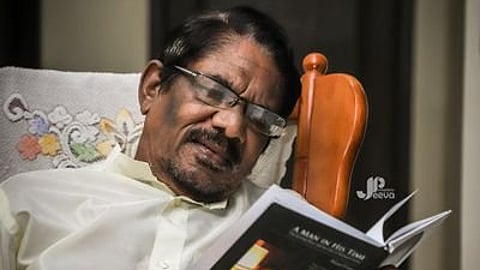

A Bharathiraja movie typically opens with him greeting audiences with folded hands and his husky voice delivering the now-iconic line, “En Iniya Tamil Makkale” (“My beloved Tamil people”).
His cinema has always spoken directly to the people and carries the smell of the earth.
Born Chinnasaamy Periyamaya Thevar in Allinagaram, Theni, on July 17, 1941, Bharathiraja would go on to become one of the most transformative voices in Tamil cinema. At a time when filmmaking was largely confined to controlled studio spaces, he dragged the camera outdoors—into fields, villages, dusty roads, and sun-baked courtyards—redefining what Tamil cinema could look and feel like.
The rural roots that shaped a filmmaker’s vision
From his early years, Bharathiraja was drawn to theatre and public expression. He was known to travel through villages speaking on social issues, using performance not as escape but as engagement. In 1963, he joined the Public Health Department as a Sanitary Inspector, earning a modest salary of Rs 75 a month, before eventually stepping away from stability to pursue cinema with near-irrational conviction.
His early creative life unfolded on makeshift stages in Theni, where he wrote, directed, and acted in plays like Oor Sirikkirathu and Summa Oru Kadhai. These village performances—often staged during festivals—became his first laboratory for narrative instinct. Later, in Madras, he continued staging plays such as Adhigaaram, while also taking up work at a petrol bunk, sustaining himself between ambition and survival.
The turning point came after years of apprenticeship in the industry. Working under filmmakers like Puttanna Kanagal, and later Krishnan Nair, Avinasi Mani, and A Jaganathan, he absorbed the grammar of cinema slowly, patiently—like someone learning a new language from the inside. A stint in documentary filmmaking further sharpened his sense of realism, convincing him that cinema could be both immediate and intimate.
The film that redefined Tamil cinema
Then came 1977, and with it 16 Vayathinile—a film that quietly detonated Tamil cinema’s studio-bound conventions. Starring Kamal Haasan, Sridevi, and Rajinikanth, it brought rural life onto the screen not as backdrop but as lived reality. The film’s success was almost ironic: conceived in the spirit of a modest, almost austere project, it ended up becoming a landmark that reshaped careers and aesthetics alike.
If 16 Vayathinile announced his arrival, Kizhakke Pogum Rail refined his sensibility. Beneath its deceptively simple narrative lay a sharp observation of caste hierarchies and gendered vulnerability in rural spaces. Bharathiraja rarely declared his themes; he embedded them. Social reality in his films is not preached—it is observed, sometimes painfully, always quietly.
He moved fluidly across genres
Over the decades, he moved fluidly across genres, directing more than 40 films. Yet even at his most experimental, he returned to certain emotional coordinates: land, love, loss, and the fragile negotiations between them. Films like Alaigal Oivathillai, Mudhal Mariyathai, and Karuthamma stand as variations on this core—each probing different fault lines of desire, tradition, and social constraint. Sigappu Rojakkal, meanwhile, revealed another side of him entirely: a psychological thriller that broke sharply from his rural signature, proving his range was never confined to landscape alone.
His Telugu work, particularly Seethakoka Chilaka, extended this sensibility beyond linguistic boundaries, earning both critical and commercial recognition, including the National Film Award for Best Feature Film in Telugu. Over time, he came to be called “Iyakkunar Imayam," meaning the pinnacle among directors whose influence quietly shaped the terrain beneath Tamil cinema itself.
What distinguishes Bharathiraja
What distinguishes Bharathiraja is not just his subject matter but his gaze. His camera treats rural Tamil Nadu not as picturesque folklore, but as charged emotional geography. The red soil of Theni, the sway of banana groves, village festivals, caste tensions simmering beneath everyday gestures—all become cinematic material without needing embellishment. In his world, landscape is never passive; it participates.
He has often insisted that he never made films to “play the caste card,” but rather to centre love as the true subject. Whether it is Vedam Puthithu, Alaigal Oivathillai, or Kizhakke Pogum Rail, caste and religion appear not as slogans but as pressures that shape human intimacy. Love, in his cinema, is never abstract—it is tested, interrupted, negotiated.
