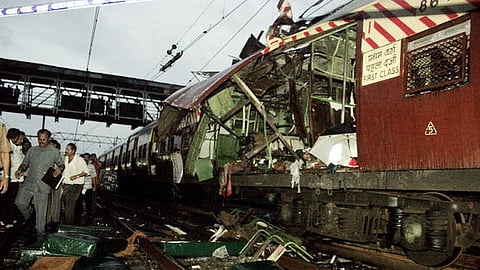

CHENNAI: In July 24, 2025, the Supreme Court issued an interim stay on a Bombay High Court judgment acquitting all 12 accused in the 2006 Mumbai train blasts case. The order, delivered by a bench of Justices M M Sundresh and N Kotiswar Singh, underscored that the high court’s verdict would not serve as a judicial precedent for other cases, particularly those under the Maharashtra Control of Organised Crime Act (MCOCA). However, the court emphasised that the accused, who had already been released from captivity, would not be re-arrested till further proceedings.
The order came following an urgent appeal by the Maharashtra government, represented by Solicitor General Tushar Mehta. The state argued that the high court’s ruling could set a problematic precedent, potentially undermining trials under MCOCA, a stringent law to combat organised crime and terrorism in Maharashtra. Mehta stressed that certain legal findings in the high court’s judgment could weaken the prosecution’s ability to secure convictions in similar cases.
The SC bench acknowledged the rarity of staying an acquittal, noting that such an action would be a “rarest of rare” occurrence. The Maharashtra government’s swift appeal was driven by political and legal pressures.
Bombay High Court’s acquittal
On July 21, the Bombay High Court acquitted all accused, overturning a 2015 special court judgment that had sentenced five to death and seven to life imprisonment. The 671-page ruling by Justices Anil S Kilor and Shyam C Chandak cited the prosecution’s “utter failure” to prove guilt, citing unreliable evidence, coerced confessions, and systemic investigative lapses, including “inhuman and barbaric” custodial torture. Within 24 hours, the Maharashtra government moved the Supreme Court, which, on July 24, stayed the order.
The 7/11 blasts
On July 11, 2006, seven coordinated bomb blasts struck Mumbai’s Western Railway suburban trains between 6.24 pm and 6.35 pm, targeting first-class compartments at Matunga Road, Mahim Junction, Bandra, Khar Road, Jogeshwari, Bhayandar and Borivali. The bombs, concealed in pressure cookers, killed 189 people and injured over 800, making it India’s deadliest terror attack by fatalities.
The Maharashtra Anti-Terrorism Squad (ATS), which led the probe, alleged that the accused, linked to the banned Students’ Islamic Movement of India (SIMI) and Pakistani operatives of Lashkar-e-Taiba (LeT), orchestrated the attacks.
In November 2006, the ATS charged 13 accused and 17 wanted individuals under MCOCA, the Unlawful Activities (Prevention) Act (UAPA), various sections of the Indian Penal Code, and other laws. In September 2015, a special MCOCA court convicted 12 accused: five of them — Kamal Ahmed Mohd Vakil Ansari (A1), Mohammad Faisal Ataur Rahman Shaikh (A3), Ehtesham Qutubuddin Siddiqui (A4), Naveed Hussain Khan (A12), and Asif Khan Bashir Khan (A13)—received death sentences for allegedly planting bombs, while seven — Tanveer Ahmed Mohammed Ibrahim Ansari (A2), Mohammed Majid Mohammed Shafi (A5), Shaikh Mohammed Ali Alam Shaikh (A6), Mohammed Sajid Margub Ansari (A7), Muzammil Ataur Rahman Shaikh (A9), Suhail Mehmood Shaikh (A10), and Zameer Ahmed Latifur Rehman Shaikh (A11) — were sentenced to life imprisonment. Abdul Wahid Din Mohammad Shaikh was acquitted. The convictions relied on confessional statements, eyewitness testimonies, and recovered items like RDX, detonators and circuit boards.
Annihilation of evidence
The high court’s acquittal centered on the prosecution's failure to prove guilt beyond reasonable doubt. The court concluded, “...Having held that the prosecution utterly failed to establish the offence beyond reasonable doubt against the accused on each count, it is unsafe to reach the satisfaction that the appellants/accused have committed the offences for which they have been convicted and sentenced.”
Challenging unreliable testimonies:
The prosecution relied on eight eyewitnesses, including taxi drivers who allegedly drove Rahman Shaikh and Bashir Khan to Churchgate, witnesses who saw bombs planted, and those claiming to have observed bomb assembly or conspiracy. The defence tore apart their credibility. The HC accepted the defence stand of inadmissibility of the test identification (TI) parades conducted by Barve as Special Executive Officer (SEO), on the ground that on the date of the parade, he had no authority to conduct them. Barve’s first tenure of four years as SEO expired on May 7, 2005. He was reassigned to the same post on November 15, 2006. And the TI parades were conducted in between, on November 6, 2006, when he was not an SEO. So, all parades conducted by him were declared as void. However, TI parades by another SEO Purandare were treated as valid.
Non-examination of key witnesses: The defence successfully argued for an 'adverse inference' due to the prosecution’s failure to call key witnesses like Ramanand Machchewar, Prabhakar Dattatray Sadekar, Vijay Kumar Rayappa and others for a TI parade. These witnesses had given early statements describing the suspects. The court noted, “We have drawn an adverse inference for not examining the material witnesses,” as the defence demonstrated that these omissions undermined the case’s foundation.
Untrustworthy witness: The defence established the lack of credibility of one witness, noting his involvement in multiple unrelated cases, including the Ghatkopar blast, and his delayed identifications (up to four years). The court found it abnormal, stating, “on these grounds and other grounds mentioned while discussing his evidence, we have not found this witness trustworthy.” The defence’s cross-examination revealed inconsistencies, such as the witness’s inability to name a bar dancer he claimed close association with, despite recalling details of meetings with Pakistani operatives.
Undermining evidence recoveries: The prosecution presented recoveries of RDX, granules, detonators, circuit boards, soldering guns, books, maps, and CPUs. The defence argued these were unreliable due to procedural lapses and lack of relevance.
Improper custody and sealing: The defence highlighted that the ATS failed to maintain proper custody and sealing of critical items like RDX and detonators. The court agreed, stating, “The evidentiary value of these recoveries does not attach any importance on the ground that the prosecution failed to establish and prove the proper custody and proper sealing, which ought to be intact till the articles were taken to FSL.” The defence’s scrutiny exposed violations of chain-of-custody protocols.
Irrelevant circuit boards: The defence argued that circuit boards recovered from Rahman Shaikh and Margub Ansari were irrelevant, as the prosecution failed to identify the bomb type. The court noted, “The prosecution failed to bring any evidence on record and to establish the type of bombs used in the present crime. Thus, the said recovery is not relevant.” The defence’s challenge severed the link between the recoveries and the crime.
Non-incriminating items: The defence contended that items like books, maps, and CPUs were insufficient to prove guilt. The court concurred, stating, “The recovery of the other articles like books, maps, CPUs, etc. are also not sufficient even if the recoveries are held to be proved, to establish the present crime against the accused.”
Discrediting confessional statements: The prosecution’s case hinged on confessional statements recorded between October 4 and 25, 2006, which the accused later retracted. The defence dismantled these through a multi-pronged attack that included proving torture to extract confessions, by presenting medical evidence from KEM and Bhabha hospitals to contend that the accused endured “inhuman and barbaric” torture during custody. The court upheld this, stating, “The accused succeeded in establishing the fact of torture inflicted on them to extort confessional statements.” This rendered their confessions involuntary under Section 24 of the Indian Evidence Act, 1872.
Procedural violations: The defence challenged the MCOCA approval process, arguing that “no relevant material was available with the authority to reach a subjective satisfaction about the compliance of pre-requisites for grant of prior approval.” They also noted “non-application of mind” and that chargesheets against Bashir Khan did not satisfy the criteria for “continuing unlawful activity”. The absence of testimony from DIG S K Jaiswal, the approving officer, was highlighted, with the court noting, “Mere identification of signature of Shri. Jaiswal by a witness does not prove the contents of prior approval.”
Identical content: The defence pointed out that confessions were “cut-and-paste,” with “identical Part-I and Part-II of some of the confessional statement” and “some portions of the same were found to be similar and copied.” This lack of specificity and truthfulness undermined their reliability.
Non-compliance with MCOCA rules: The defence noted that confessions of Vakil Ansari, Rahman Shaikh and Mehmood Shaikh lacked mandatory certificates under Sub-Rule 6 of Rule 3 of the MCOCA rules. They also argued that the prosecution failed to establish voluntariness through oral evidence from DCPs. The court concurred. Variations in DCP correspondence about offenses further weakened the confessions.
Dubious call data records: The defence argued for an adverse inference due to the prosecution’s failure to produce CDRs, critical for establishing communication links in the alleged conspiracy. The court found merit in it. The defence’s emphasis on this lapse suggested the ATS withheld evidence.
What lies ahead?
The Supreme Court’s stay has set the stage for a critical legal battle. The accused, now free, must respond to the court’s notices, potentially relitigating issues of evidence and procedure. The final ruling could have far-reaching implications for India’s anti-terrorism laws, investigative practices, and the balance between security and individual rights.
