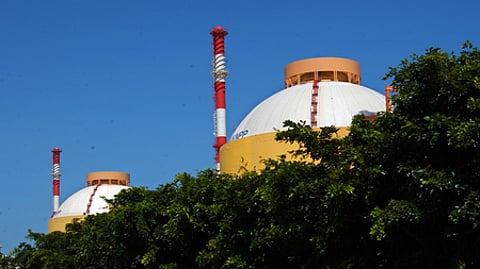

In a bid to achieve clean energy goals and a target of 100 gigawatts of nuclear capacity by 2047, Parliament has just approved a Sustainable Harnessing and Advancement of Nuclear Energy for Transforming India Bill, 2025 (SHANTI Bill). The bill proposes to repeal and replace the Atomic Energy Act, 1962, and the Civil Liability for Nuclear Damage Act, 2010 (“existing laws”), and to introduce a consolidated legal framework. The bill now awaits Presidential assent to become an Act.
The main feature of the bill is paving the way for private participation, along with foreign investment, in the nuclear sector. In simple terms, the bill will make it easier for private players such as the Adani Group, Larsen & Toubro (L&T), and Tata Power Ltd. to enter India’s nuclear sector and contribute to the country’s atomic energy development. The bill also paves the way for the regulated usage of nuclear and radiation technologies in areas such as healthcare, food and agriculture, industry, and research.
Why the bill
The Minister of State (Independent Charge) for Science and Technology, Dr Jitendra Singh, stated in Parliament that the bill seeks to modernise India’s nuclear framework in line with contemporary technological, economic, and energy realities, while retaining and strengthening the core safety, security and regulatory safeguards that have been in place since the Atomic Energy Act, 1962.
The minister explained that times have changed and technology has evolved, making it feasible to expand the role of nuclear energy in the power sector. He pointed out that nuclear energy has applications beyond electricity generation, including cancer care, agriculture and industry. The minister also highlighted that concepts such as Small Modular Reactors (SMRs) and Bharat Small Reactors were unimaginable 15 years ago but are now emerging as safe, efficient, and flexible solutions for clean, round-the-clock power generation.
As of December 2025, India has a total installed nuclear power capacity of 8,780 MW (8.78 GW), which is 3% of total electricity generation in the country.
Licence eligibility
Earlier, nuclear power generation was restricted to the Union government and government-controlled entities such as the Nuclear Power Corporation of India Limited (NPCIL) under the Atomic Energy Act, 1962. The SHANTI bill changes this by allowing limited private participation, subject to strict regulation.
Under the bill, eligible applicants include Central government departments, government-owned companies, private Indian companies, joint ventures among these entities, and any other person specifically permitted by the Central government. A licence is mandatory to build, own, operate, or decommission a nuclear power plant or reactor. Licences are also required for activities such as the fabrication of nuclear fuel (within limits notified by the government), the transportation or storage of nuclear fuel or spent fuel, and the import or export of nuclear materials, equipment, technology or software.
As per the bill, licences will be granted for a fixed period and may be renewed, modified, suspended, or cancelled if safety, security, or public interest is at risk. The bill exempts peaceful nuclear research and innovation from licensing requirements.
What remains under govt control
Although the bill opens the sector to private participation, the government retains strict control over nuclear materials and strategic activities. Under the SHANTI bill, all uranium and other fissile materials remain under government monitoring. Spent nuclear fuel must be safely stored for a prescribed cooling period and then handed over to the government for further management. Heavy water used in nuclear facilities must also be returned to the government after its intended use, with the cost borne by the operator.
Certain highly sensitive activities remain exclusively reserved for the Central government or its wholly owned entities. These include advanced uranium enrichment, reprocessing of spent fuel, management of high-level nuclear waste, and the production and upgrading of heavy water. Uranium and thorium mining is also restricted entirely to the government or government-controlled companies. All such minerals vest in the Union government and cannot be sold or transferred without prior approval.
Liability for nuclear damage
As per the bill, if a nuclear accident occurs, the operator of the nuclear installation is responsible for the resulting nuclear damage. This includes accidents at the plant and those involving nuclear material during transport, depending on who had custody of the material at the time. If more than one operator is involved and responsibility cannot be divided, all operators are jointly liable within the limits set by the law. However, operators are not liable if the damage is caused by extraordinary natural disasters, war, terrorism, or civil unrest. They are also not responsible for damage to the nuclear plant itself, nearby installations, or transport vehicles. If damage occurs due to a person’s own negligence, the operator is not liable. Compensation for each nuclear incident is capped at 300 million Special Drawing Rights (SDRs). If damages exceed this limit, the Central Government steps in and may use a Nuclear Liability Fund to pay additional compensation.
The bill categorises breaches of nuclear law into four levels: severe, major, moderate, and minor, each carrying different penalties. Severe violations attract fines ranging from J50 lakh to J1 crore, major violations from J10 lakh to J50 lakh, moderate violations from J5 lakh to J10 lakh, and minor violations from J50,000 to J5 lakh. The penalty depends on the seriousness of the breach. Repeated or negligent actions can result in higher fines or imprisonment.
The bill also specifies financial liability limits for operators of nuclear installations in case of accidents. These limits depend on the reactor’s thermal power or the type of facility: reactors above 3,600 MW have a liability limit of J3,000 crore, reactors between 1,500 MW and 3,600 MW have a limit of J1,500 crore, reactors between 750 MW and 1,500 MW have a limit of J750 crore, reactors between 150 MW and 750 MW have a limit of J300 crore, and smaller reactors, fuel cycle facilities, and transportation of nuclear material have a limit of J100 crore.
Who can file the claim
As per the law, anyone who suffers nuclear damage in India, on Indian ships or aircraft, on Indian artificial islands, or in India’s waters can claim compensation. Claims can also be made for damage in another country caused by a nuclear incident in India under certain conditions. The Central government will appoint Claims Commissioners to handle them. If the damage is very large, it can set up a Nuclear Damage Claims Commission.
The Commission will have a Chairperson, who must be a former high court judge, and expert members. They would manage cases, form benches to hear claims, and follow a flexible procedure, including summoning witnesses and hiring experts. Claims can be made by injured persons, property owners, legal representatives of the deceased, or authorised agents, and must be filed within three years of knowing about the damage. The Commission would follow a flexible procedure, can summon witnesses, examine documents, and hire experts if needed. Awards must be made within three months of receiving a claim, and the insurer pays its share while the operator pays the remaining amount up to the maximum liability. If payment is delayed, it can be recovered as land revenue. Claims must be filed within 10 years for property damage and 20 years for personal injury.
Role of AERB
The SHANTI bill gives legal status to the Atomic Energy Regulatory Board (AERB), making it India’s official nuclear and radiation safety regulator. Earlier, the AERB worked through a government order, but now it will function under a clear law, strengthening its authority and independence.
The Board will have a Chairperson, one whole-time member, and up to seven part-time members, all appointed by the Central government. The main role of the AERB is to ensure safety. It sets limits on radiation exposure, issues safety authorisations, and frames safety standards for nuclear plants, hospitals, research centres, and other facilities using radiation. It also monitors radioactive waste, inspects facilities, and can recommend suspension or cancellation of licences if safety rules are violated.
Opposition a-SHANTI
Congress leader Shashi Tharoor criticised allowing private companies into India’s nuclear sector. He said that when one company controls every step, the risks multiply. Profit motives could make safety checks seem like costly obstacles rather than essential rules. Tharoor also questioned the compensation cap for nuclear accidents, set at 300 million Special Drawing Rights (around J3,900 crore or $460 million). By comparison, the Fukushima cleanup in Japan has already cost over $182 billion. If a private reactor causes massive damage, the difference would fall on taxpayers, he warned.
Tharoor also assailed the time limits set for victims to claim compensation, arguing that it ignores the long-term effects of radiation, which may appear decades later.
NCP MP Supriya Sule also raised concerns, asking why a profitable public sector company like NPCIL should be privatised. She pointed out that the bill limits the Right to Information (RTI), which could reduce transparency, especially when private players are involved.
Tharoor and Sule both questioned whether nuclear power is financially wise. Building reactors is extremely expensive—estimates suggest J19.3 trillion—and takes years, while costs for solar and wind energy continue to fall, and battery technology is improving rapidly.
