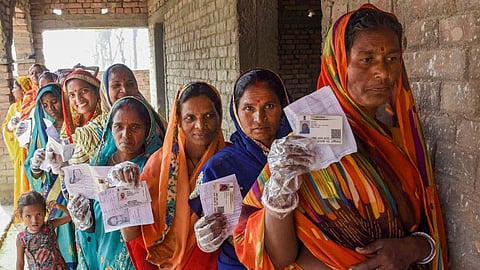

Bihar’s political future for the next five years will be decided on November 14, with the state polls also seen as a barometer of the national mood nearly two years after the BJP-led NDA returned to power at the Centre.
Yet, the decisive factor in Bihar goes beyond promises to tackle unemployment and poverty. As elsewhere in India, caste remains central to determining who forms the government.
Here is a look at Bihar's complex caste equations:
The EBC factor
According to the 2023 caste survey, Extremely Backward Classes (EBCs) account for more than 36 per cent of Bihar’s 13.07 crore population, while Other Backward Classes (OBCs) make up 27 per cent.
EBCs, outside the Scheduled Caste category, are among the most underprivileged groups in Bihar, with limited representation in government. They rank just above Dalits in land ownership and wealth.
Historically, the EBCs have supported JD(U) and Nitish Kumar, whose own Kurmi community constitutes about 3 per cent of the population. Kumar strengthened his support by implementing policies favouring the EBCs. However, with his declining image and perceived policy shortfalls, some EBC voters could shift allegiance this time.
The Mahagathbandhan has sought to court the community, inducting Mukesh Sahani’s Vikassheel Insaan Party (VIP) and IP Gupta’s Indian Inclusive Party (IIP).
At the organisational level, the RJD has signalled a push beyond its traditional Yadav-Muslim base, appointing Dhanuk caste leader Mangani Lal Mandal as state chief and adopting the “MY+BAAP” (Muslim-Yadav plus Bahujan, Aghada, women, and Poor) slogan.
Dalits
Scheduled Castes make up about 20 per cent of Bihar’s population, with notable sub-groups such as the Paswans and Manjhis enjoying relatively greater political representation and resources.
For the NDA, leaders like LJP(RV) chief and Union Minister Chirag Paswan and HAM’s Jitan Ram Manjhi bring weight in these communities. Meanwhile, Mahagathbandhan has roped in Pashupati Kumar Paras, brother of the late Ram Vilas Paswan, to attract Dalit votes.
Less privileged Dalit sections tend to support Left parties, while historically, some ‘Mahadalits’ have backed Nitish Kumar for his welfare initiatives.
Muslims
Muslims constitute 17.7 per cent of Bihar’s population and have traditionally supported the RJD.
Nitish Kumar, who maintained a “secular” image even within the NDA, also retained significant Muslim support, particularly among women. However, perceived inaction on issues affecting communal harmony could see the Muslim vote swing away from Kumar.
The Mahagathbandhan has also gained from prominent Pasmanda Muslim leader and two-term Rajya Sabha MP Ali Anwar Ansari joining the Congress, potentially consolidating the Pasmanda vote.
Yet, Asaduddin Owaisi’s AIMIM may attract a section of Muslim voters seeking an alternative to larger parties.
Dominant castes
Brahmins, Bhumihars, and Rajputs make up about 11 per cent of Bihar’s population and generally support Hindutva politics, forming a key BJP vote bank. Congress hopes to win over some of these voters, while Prashant Kishor’s Jan Suraaj Party could cut into the dominant caste vote, potentially affecting NDA prospects.
