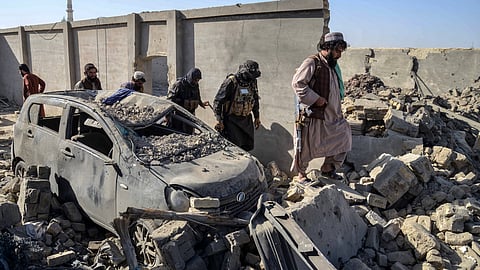

On September 22, Pakistan’s air force bombed select villages in the country’s remote Khyber Pakhtunkhwa province bordering Afghanistan. Several JF-17 jets flew over the area and dropped eight Chinese-made LS-6 precision-guided glide bombs — in an apparent bid to obliterate parts of the villages. Initial reports said at least 30 civilians, including women and children, were killed in the pre-dawn strikes that flattened multiple houses killing the inhabitants in their sleep.
The unusual attack sparked protests in the Pashtun-dominated province and raised questions as to why the Pakistan military was attacking its own people. Pakistani media reports said the strikes were against the Tehreek-i-Taliban Pakistan (TTP), known for its guerilla warfare tactics and hostility towards Pakistani security forces.
However, the high civilian casualties in Khyber put the Pakistani military on the back foot, and the domestic opposition parties accused it of endangering the lives of civilians with its reckless air strikes. Pakistan’s human rights body also hit out at the military, expressing shock over the civilian deaths and demanded an impartial inquiry into the incident.
The strikes were part of a larger plan to deal with the spurt in TTP attacks on the Pakistani military. Pakistan accused the Taliban government of harbouring TTP fighters, a claim rejected by the Afghan Taliban.
Rapid escalation
Following the initial Khyber strike, Pakistan launched further attacks inside Afghan territory on October 9, targeting TTP positions in Kabul, Khost, Jalalabad, and Paktika. Its jets and drones targeted key TTP commanders, including the outfit’s chief Noor Wali Mehsud. The TTP chief escaped unhurt as he was travelling in an armoured vehicle, but over 40 civilians were reportedly injured in the Kabul attack and considerable structural damage was inflicted on the Afghan border.
On October 11-12, Taliban forces struck Pakistani border posts in at least five provinces. Pakistan responded with airstrikes in Kandahar and Helmand provinces, killing some Taliban fighters. Finally, a ceasefire brokered by Saudi Arabia and Qatar was announced on October 15. Yet, Pakistan kept up its attacks, including the bombing of Paktika, killing three Afghanistani cricketers.
Root cause
Tensions worsened after Islamabad demanded that Kabul take action against the TTP elements operating from Afghan territory. However, the Afghan Taliban’s stated position is that the Pakistan Taliban is not present on its soil, so the question of acting against the outfit doesn’t arise. According to some estimates, as many as 2,500 Pakistani security personnel have been killed by the TTP in the first nine months of 2025 alone. Besides, TTP fighters have systematically targeting Chinese projects in Pakistan.
Early this month, Afghan Taliban launched armed raids on border posts along the Durand Line in response to Pakistan’s bombing in Kabul and a market in the country’s east. For the Taliban, Pakistan’s violating its airspace is an affront to its sovereignty, which will not be tolerated. It said independence and respect are non-negotiable.
Short-term objectives
Strategically, Islamabad’s repeated strikes on TTP strongholds aim to weaken the outfit and pressure Kabul to curb cross-border militancy. Politically, the Pakistan government faced intense domestic pressure after thousands of security personnel were killed in ambush and suicide attacks. So, it was forced to go after the TTP. As for the Afghan regime, it considers its military response would provide it a rallying point domestically to consolidate power. Significantly, Afghanistan also reportedly snubbed Pakistan by denying visa to its Defence Minister Khawaja Asif and ISI chief Asim Malik, not just once but thrice.
India angle
Traditionally, India has supported Afghan governments and successfully maintained soft power influence through infrastructure projects and diplomatic ties. From a strategic point of view, the Afghan-Pakistan conflict could help India as it has the potential to destabilise Islamabad while keeping the Pakistani defence forces busy. If Pakistan remains entangled in the militancy menace, it could give India some advantage in strengthening its own counter-terrorism operations.
Although India officially abstains from any direct involvement in the conflict, it maintains diplomatic communications with the Afghan Taliban to safeguard its interests. The recent visit by Taliban’s foreign minister Amir Muttaqi and New Delhi’s decision to upgrade its technical mission in Kabul are part of this strategy.
David vs Goliath
The Afghan Taliban said that it agreed to pause its retaliatory strikes after requests from Saudi Arabia and Qatar. However, the temporary peace could evaporate unless the underlying issues are resolved. If a direct war breaks out between Pakistan and Afghanistan, it could trigger a shift in regional power dynamics.
Pakistan’s military is mightier with over 6,60,000 active personnel. It is estimated to have around 2,200 tanks, 900 aircraft, and a range of missiles and nuclear weapons, mostly supported by Chinese technology.
In contrast, Taliban has around 1,72,000 fighters — most of whom have guerrilla warfare experience but limited heavy weaponry or air capabilities. Also, Afghanistan’s military equipment mainly consists of outdated Soviet-era arms and other weapons left behind by the US after its 2021 withdrawal. However, Taliban fighters are said to have more territorial knowledge, insurgency tactics, and decentralised command structures.
Way forward
Afghanistan and Pakistan have a complicated history. Pakistan strongly backed the Taliban after it was ousted from power in 2001 and continued to support it during the subsequent insurgency against the US-backed Afghan government. Also, Pakistan hosted millions of Afghan refugees over decades of war, though it started expelling many of them in recent years.
The TTP’s presence will continue to be a key irritant for Pakistan, but experts believe the border clashes are unlikely to escalate into a larger conflict. Islamabad at present is not ready for a full-fledged war. However, tension is likely to prevail in the short term as TTP fighters can be expected to keep needling Pakistan.
