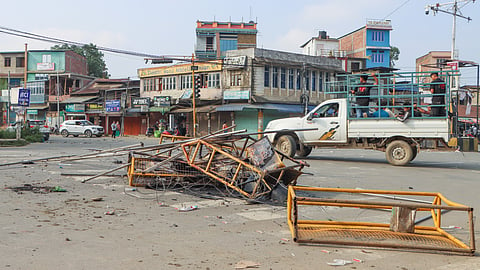

GUWAHATI: Twenty-eight months have rolled by since Manipur was hit by a bloody ethnic violence that claimed over 250 lives, displaced some 62,000 others, internally partitioned the state and caused cessation of co-existence between Meiteis and Kuki-Zo tribals, the two communities caught in the conflict.
Last week, Prime Minister narendra Modi visited the state for the first time with a “development package” balm, but Manipur seeks much more. All communities in the still beleaguered state, where interaction between the warring communities is frozen in a disturbed time, want a definitive plan for peace.
Present status
There is some progress in terms of peace and economy. The market is picking up. There is some semblance of security among people living in inter-district border areas which separate people from the two communities. Farming activities, especially in the ‘buffer zone’ where the Meitei-dominated Imphal Valley and the Kuki-Zo-dominated hills meet, started after the guns had fallen silent.
But people still do not feel fully secure as these areas witnessed deaths and destruction during the conflict. Both communities still cannot go to each other’s areas. For the Meiteis, air travel from Imphal is the only option to leave the state. Kuki-Zo tribals, settled in south-western parts of the state, can leave the state by undertaking 15-20 hours of arduous road journey to adjoining Mizoram. Those living in eastern and northern parts can travel by road to go to nagaland and beyond.
PM Modi’s visit
The visit had generated a lot of expectation considering that it was his first to the state since the violence broke out. People, particularly Meiteis and Kukis, were hoping the PM would help find a way for reconciliation and restoration of normalcy. But the mood changed when posters of him, put up in the Imphal Valley and Kuki-Zo heartland Churachandpur, virtually announced the purpose of the visit – inauguration of development projects worth Rs 1,200 crore and laying the foundation stone for similar projects worth over Rs 7,300 crore.
Yet, on September 13, the D-Day, there was a lot of excitement among the Kuki-Zos. People, including students, lined up on both sides of a road to welcome Modi – the first by a PM to the region in nearly 40 years. that burst of enthusiasm, however, was short-lived. In his brief address at a programme, there was no mention of a “separate administration”, a contentious demand of the Kuki-Zos, nor did he meet its MLAs.
On the same day, the Kuki-Zo Council (KZC), a major organisation of the community, submitted a memorandum to the PM reiterating the demand of separate administration in the form of a Union territory with legislature under Article 239A of the Constitution of India. The organisation stated that the demand arose, not from convenience, but from necessity—for peace, security, and survival. Around 65 km away, in the state capital Imphal, where the PM had the second and last programme, Meiteis were equally upset after listening to him.
For, he was equally silent on three burning issues – free movement, resettlement of their displaced people and illegal migration from Myanmar. Illegal migration was one of the triggers of the ethnic violence. Meiteis expected clarity on resettlement — when will people be able to return to their homes in the hills, how will their safety be ensured, and what rehabilitation packages will be offered? they wanted the Centre to bring a structured roadmap for normalcy.
How open is “reopened” National Highway 2
Manipur has two national Highways: 2 and 37. National Highway 2, which enters from nagaland, is Manipur’s lifeline. National Highway-37 enters the state from Assam’s Barak Valley. It is a longer route and less preferred by commuters as well as transporters.
On September 4, the Press Information Bureau issued a statement, stating that the KZC has “decided today to open the national Highway 2 for the free movement of commuters and essential goods”.
The decision followed a series of meetings that KZC had with the Ministry of Home Affairs in new Delhi. However, two days later, two umbrella organisations of Kuki-Zo rebel groups said KZC’s appeal was specifically confined to the Kangpokpi stretch, “aimed at encouraging cooperation with central security forces to ensure the safe passage of essential goods.”
After the PM left the state, the KZC issued a “clarification to the Meitei public regarding false claims and misinterpretations of our recent statement on national Highway NH 2”.
The organisation said it had not declared the reopening of NH-2 and no free movement had been permitted on this route. “…As there is still no settlement or agreement on the conflict between the Meitei and Kuki-Zo communities, no one from either side must cross the buffer zone under any circumstances… Any violation will only lead to serious consequences and further deterioration of peace and security,” the KZC warned.
Everyone agrees that the reopening of NH 2 could be the first step towards restoring peace and normalcy although in the light of the ethnic divide and underlying tension, Meiteis are unlikely to use this road anytime soon even if there is an understanding.
Progress of reconciliation efforts
The nagas are one of the three major communities of Manipur. Earlier, the Centre had involved naga leaders to broker peace between Meiteis and Kuki-Zos but did not get any success.
A notable effort for reconciliation was made on August 8 this year when the Thadou Inpi Manipur, the apex civil society organisation representing the Thadou tribe, held a closeddoor meeting with major Meitei groups in Imphal. the meeting was dubbed “historic.”
The Thadous, who resent being tagged as Kukis, too were affected by the conflict. that was for the first time after the conflict that they had stepped into the Meitei-majority Imphal Valley.
Status of resettlement
In the first week of July, the then Manipur Chief Secretary PK Singh had told the media the process to resettle the displaced people, lodged in relief camps, was on. Now, after more than two months, there are no official figures indicating the number of people resettled.
There is no denying that some people have been resettled but not in areas from where they had been displaced. Singh had then stated that resettlement would be carried out in three phases, the first of which was underway. He had also stated that the state government prepared the resettlement plan following discussions with the Centre.
Back then, an estimated 57,000 people were lodged in relief camps. The government had plans to close down the camps by December following resettlement. Those who exited them moved into prefabricated houses, each measuring 20 feet by 20 feet and worth Rs 9.3 lakh. Most of the occupied houses are in the Imphal east and Imphal west districts. The Manipur Police Housing Corporation Limited has been entrusted with constructing these prefabricated units.
However, the displaced people lodged in relief camps want to return to their original homes – the Meiteis in the hills and the KukiZos in the Imphal Valley. They staged protests earlier demanding their resettlement.
The PM, during his visit, met with such people in Churachandpur as well as Imphal. They just want to return to their homes which are either burnt or damaged. the destruction hardly matters. they want to go to the place where they lived their lives.
“Modi ji, please take us home.” This was the appeal of a Meitei woman on the eve of the prime minister’s Manipur visit.
Not just the displaced people, all communities are longing for the pre-violence days when they lived together in absolute peace and were not suspicious about one another.
Who got what?
PM Modi’s September 13 visit to Manipur emphasised inclusive development across the hill (Kuki-Zo) and valley (Meitei) areas, but projects were not explicitly labeled as “for” one community.
Instead, they were tied to locations: Rs 1,200 crore inaugurated in Imphal (Meitei majority valley) and Rs 7,300 crore foundations laid in Churachandpur (Kuki-Zo stronghold). A key statewide initiative supports displaced families from both sides.
For Meitei (Valley/Imphal focus)
Civil Secretariat in Mantripukhri, Imphal: Inaugurated to strengthen governance in the Meitei-dominated capital.
New Police Headquarters in Mantripukhri, Imphal: Inaugurated to bolster security in valley districts.
IT SEZ Building in Mantripukhri, Imphal: Inaugurated to drive tech growth in the valley.
Manipur Urban Roads, Drainage, and Asset Management Project: Foundation laid for sewerage and road upgrades in Imphal urban areas.
For Kuki-Zo (Hills/Churachandpur focus)
Manipur Infotech Development (MIND) Project: Foundation laid for IT parks and incubators in Churachandpur to create opportunities in hill districts.
National Highway and Rural Road Projects: Foundations laid for upgrades (eg: NH 2 stretch connecting Churachandpur and remote hill villages).
Working Women’s Hostels (nine facilities): Foundations laid across hill districts like Churachandpur to support Kuki-Zo women.
Super-speciality Health Care Facilities: Foundations laid in remote hill districts for better medical access.
Joint/ Statewide (Benefits both communities)
Construction of 7,000 new homes: Central govt support announced for displaced families (including ~20,000 Meiteis and ~40,000 Kuki-Zo) in camps across Imphal and Churachandpur.
Eklavya Model Residential School in Tlangnuam (hill district): Inaugurated for tribal (Kuki-Zo and Naga) students, with valley access
Upgrades to 120 schools: Foundations laid across 16 districts, covering both hill and valley.
Ima markets (women’s markets in four districts): Inaugurated for local commerce in mixed areas Manipur.
Bhavans in Delhi and Kolkata: Inaugurated to promote shared cultural heritage.
