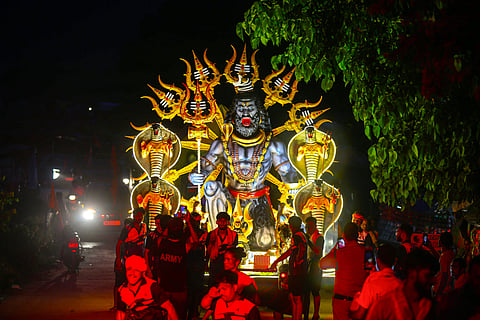

With the arrival of the holy month of Shrawan on July 30, thousands of devotees of Lord Shiva, dressed in saffron, are once again performing an ancient ritual. Carrying bamboo Kanwars filled with holy Ganga water, they walk barefoot over long distances to perform Jalabhishek at Shiva temples across north India. What began as a deeply personal act of devotion has grown into one of the world's largest annual religious pilgrimages, with participation now estimated at over four crore devotees. Alongside faith, the Yatra today also demands massive administrative planning, security deployment and traffic management.
TIMELINE
Mythological Era:
Different traditions trace the origin of the first Kanwariya to Lord Ram, Ravana, or Lord Parashuram.
Treta Yuga Tradition:
Lord Ram is believed to have carried Ganga water from Sultanganj (Bihar) to Deoghar (Jharkhand) and offered it to Lord Shiva after Bhagiratha brought the Ganga to Earth.
Ramayana Tradition:
Another belief states that Ravana carried Ganga water from Haridwar to Pura Mahadev Temple in present-day Baghpat.
Parashuram Tradition:
Some traditions credit Lord Parashuram with carrying Ganga water from Brajghat (Garhmukteshwar) to Pura Mahadev Temple.
Centuries Thereafter
The Kanwar Yatra continued as a regional pilgrimage centred on the worship of Lord Shiva.
1990s:
Participation expanded rapidly across Uttar Pradesh, with about 20 lakh devotees joining annually.
2000s:
Organised camps, free food stalls, and vehicle-assisted Kanwars became common features of the pilgrimage.
2015:
Annual participation reached nearly two crore devotees.
Present Day:
More than four crore devotees participate every year, making the Kanwar Yatra one of the world's largest annual religious pilgrimages, supported by dedicated traffic corridors, surveillance systems, and digital monitoring.

What is the Kanwar Yatra?
Kanwar Yatra is an annual pilgrimage undertaken during the holy month of Shrawan. Devotees collect water from the Ganga and carry it in decorated bamboo Kanwars suspended across their shoulders. Walking barefoot, they travel to Shiva temples where they offer the sacred water in a ritual known as Jalabhishek.
Why is it held during Shrawan?
Shrawan is considered the holiest month for the worship of Lord Shiva. Offering Ganga water to Shiva during this period is believed to bring spiritual merit and fulfil prayers.
What's new this year?
This year, the Uttar Pradesh government has focused on identifying establishments along Kanwar routes, more strictly enforcing restrictions on meat and liquor outlets, strengthening traffic management, tightening security and improving coordination with neighbouring states.
Which states see the largest number of Kanwariyas?
Uttar Pradesh attracts the highest number of Kanwariyas, followed by Uttarakhand, Haryana and Delhi. During Shrawan, highways across western Uttar Pradesh turn into long streams of saffron-clad pilgrims heading towards Shiva temples.
Who was the first Kanwariya?
There is no single accepted tradition. Hindu mythology offers three widely followed beliefs.
Theory 1: Lord Ram
According to one tradition, Lord Ram carried Ganga water from Sultanganj in present-day Bihar to Deoghar in Jharkhand and offered it to Lord Shiva. The journey is linked to King Bhagiratha bringing the Ganga to Earth.
Theory 2: Ravana
Another belief holds that Ravana, one of Shiva's greatest devotees, carried Ganga water from Haridwar to Pura Mahadev Temple in present-day Baghpat after Shiva consumed the poison released during Samudra Manthan.
Theory 3: Lord Parashuram
A third tradition credits Lord Parashuram with bringing Ganga water from Brajghat at Garhmukteshwar and offering it at Pura Mahadev Temple after severe penance dedicated to Lord Shiva.
What are the different types of Kanwar Yatra?
Though every Kanwariya carries Ganga water, the pilgrimage is performed in different ways.
Bol Bam Kanwar: The most common form. Pilgrims may rest, but the Kanwar must never touch the ground.
Khadi Kanwar: The Kanwar always remains upright. A helper supports it whenever the pilgrim rests.
Jhula Kanwar: The Kanwar is specially designed with pots hanging on both sides and is suspended whenever the pilgrim stops.
What is unique about Dak Kanwar?
Dak Kanwariyas complete the journey without stopping after collecting Ganga water and perform Jalabhishek within 24 hours. It is regarded as one of the fastest forms of the pilgrimage. Many temples provide separate lanes for them.
How is Dandavat Kanwar different?
It is considered the toughest form of the pilgrimage. Devotees repeatedly lie fully prostrate on the ground, mark the distance covered by their body length and continue this process until they reach the temple. The journey often takes several days.
What rules Kanwariyas have to follow?
The pilgrimage is governed by strict religious discipline: Walk barefoot throughout the journey; abstain from alcohol, tobacco and all intoxicants; follow a strictly vegetarian diet; avoid leather items; sleep on the ground; ensure the Kanwar never touches the ground; address fellow pilgrims as "Bhole" or "Bam" instead of using personal names; maintain humility, discipline and respectful behaviour throughout the Yatra.
What are the major Kanwar routes in Uttar Pradesh?
The movement of Kanwariyas is concentrated in districts such as Meerut, Ghaziabad, Prayagraj, Agra, Gautam Buddh Nagar, Kasganj and Varanasi.
Most pilgrims cover between 50 and 150 kilometres on foot. Popular routes include:
152 km: Haridwar to Pura Mahadev Temple, Baghpat.
139 km: Haridwar to Aughadnath Temple, Meerut.
112 km: Prayagraj to Kashi Vishwanath Temple, Varanasi.
120 km: Bithoor to Lodheshwar Mahadev Temple, Barabanki.
55 km: Kachhla Ghat to Bankhandi Nath Temple, Bareilly.
How has the Yatra changed over the years?
In the 1990s, around 20 lakh devotees participated every year. During the 2000s, vehicle-assisted Kanwars, organised camps, food stalls and accommodation facilities became common. By 2015, participation had climbed to nearly two crore.
Today, the pilgrimage attracts over four crore devotees. Dedicated Kanwar lanes, GPS navigation, social media, CCTV surveillance and drone monitoring have become integral to the Yatra.
What security arrangements are made?
The Yatra requires one of the country's largest annual security operations. Under Uttar Pradesh's "zero incident, zero accident" plan this year, authorities have deployed:
35,000 civil police personnel.
151 companies of the Provincial Armed Constabulary (PAC).
11 companies of paramilitary forces.
Security deployment across 840 sensitive stretches.
Around 10,000 volunteers.
Anti-Terrorism Squad (ATS), National Disaster Response Force (NDRF), and State Disaster Response Force / Fund (SDRF) teams at key locations.
What role does technology play?
Authorities have installed 29,454 CCTV cameras and deployed 400 drones for surveillance. Around 1,222 police help desks and 829 medical camps have been set up along the routes. District administrations monitor crowd movement in real time, while helicopters shower flower petals on pilgrims in several districts as a symbolic welcome.
Do law-and-order problems occur during the Yatra?
The overwhelming majority of pilgrims complete the Yatra peacefully. However, incidents involving highway blockades, vehicle vandalism, clashes with police and traffic disruption do occur.
Police increasingly rely on CCTV footage and drone surveillance to identify offenders. Those found involved in rioting, damaging property or obstructing public servants are booked under criminal law.
What is the economic significance of the Kanwar Yatra?
The Kanwar Yatra has become one of India's biggest seasonal religious economies. With more than four crore pilgrims participating, it is estimated to generate economic activity worth Rs. 8,000 crore to Rs.16,000 crore. Local traders, transport operators, dhabas, roadside vendors, hotels, tent operators and sellers of religious items witness a sharp rise in business. On average, a Kanwariya spends between Rs. 2,000 and Rs. 4,000 during the pilgrimage.