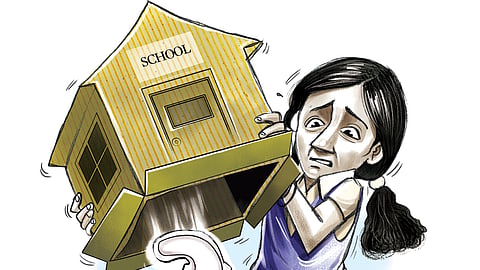

A girl's education should not stop because of her periods. On January 30, the Supreme Court delivered a judgment that many educators and activists had been waiting for. In a petition filed by Dr Jaya Thakur, a social worker, the court addressed the utter lack of menstrual hygiene management in schools and its crushing impact on girls' education.
A bench of justices J B Pardiwala and R Mahadevan didn't just issue directions. They went deeper, asking and answering four basic questions that reframe how we think about menstruation, education, and constitutional rights. As Justice Pardiwala noted in the judgment's opening, quoting American educator Melissa Berton: "A period should end a sentence – not a girl's education."
Problem at hand
The numbers are stark. Across India, lakhs of girls between classes 6 and 12 miss school or drop out because of inadequate menstrual hygiene facilities. The petition sought basic provisions — free sanitary pads for female students, separate toilets for girls in all government-aided and residential schools, cleanliness measures, and awareness programmes on menstrual health.
Justice Pardiwala structured the analysis around four sharp questions, each addressing a different dimension.
Question one: Does education qualify as a fundamental human right, and if so, what it means for menstrual hygiene?
The court's answer was unequivocal. Drawing from international human rights frameworks, including the Universal Declaration of Human Rights, the ruling established that education is indeed a fundamental human right. The court also examined what "access to education" truly means.
The judgment noted that education is not merely about enrollment numbers or school buildings. True access to education means creating an environment where every child can attend and participate without barriers. For millions of girls, menstruation creates such a barrier. When schools lack proper toilets, when sanitary products are unaffordable or unavailable, when the stigma around periods forces girls to stay home, their fundamental right to education is violated. The court recognised that menstruation acts as "a barrier to the right to access education".
Question two: Does menstrual hygiene fall under Right to Equality?
The second question addressed whether the lack of menstrual hygiene facilities violates Article 14 of the Constitution, which guarantees equality before law and equal protection of laws. Here, Justice Pardiwala employed a "substantive approach to the right to equality in education". The court didn't just ask whether girls and boys have equal access to schools on paper. Instead, it examined whether they have equal ability to actually benefit from that access.
The judgment emphasised that menstruation creates a unique disadvantage for female students, one that requires active measures to correct rather than passive neutrality.
The court also addressed the intersectionality of disability, gender, and access to education. For girls with disabilities or specific health conditions, like PCOS (Polycystic Ovary Syndrome) and PCOD (Polycystic Ovarian Disease), both of which affect the ovaries, lack of menstrual hygiene facilities worsen the barriers.
By framing menstrual hygiene as an equality issue, the court established that providing these facilities isn't charity or a welfare measure, but a constitutional obligation much, much needed to make sure education reaches all.
Question three: Is dignified menstrual health part of Article 21's Right to Life?
The judgment first establishes that human dignity is part of the right to life. Dignity isn't an abstract concept, but one that manifests in the ability to manage one's bodily functions with privacy, cleanliness, and without shame. When schools lack proper toilets, when girls have no access to sanitary products, when they must use unhygienic materials or miss school entirely, their dignity is compromised.
The judgment then linked menstrual health to the right to privacy and decisional autonomy. Every girl should have the autonomy to manage her period without having to make impossible choices, between attending school or staying clean, between buying food or buying pads, between education and health. Most significantly, the court recognised menstrual health as a specific facet of the right to life under Article 21. The judgment doesn't just say that schools should provide sanitary facilities as a matter of policy convenience. It establishes that access to menstrual hygiene products and facilities is a constitutional right.
Question four: Does menstrual hygiene management fall under Article 21A and RTE Act?
The fourth question brought these constitutional principles down to practical implementation. Justice Pardiwala examined whether menstrual hygiene management is mandated under Article 21A (right to education) and the Right to Education (RTE) Act, 2009. He analysed Section 3 of the RTE Act, which addresses barriers to free and compulsory education. The judgment held that the inability to afford menstrual hygiene products constitutes a "financial barrier" under this provision.
Just as the RTE Act ensures that lack of money shouldn't prevent a child from attending school, it must also ensure that the cost of managing menstruation doesn't drive girls away.
The court also examined Section 19 of the RTE Act, which empowers the government to prescribe minimum norms and standards for schools. Justice Pardiwala held that menstrual hygiene management measures—including toilets, sanitary products, disposal facilities, and awareness programmes—should be considered mandatory "norms and standards" that every school must meet.
This reframing is very important. Schools can't meet basic standards required by RTE Act if they don't provide for menstrual hygiene. It's not optional, it's foundational. The judgment also addressed something often overlooked—the role of men in menstruation. The court emphasized that male teachers, administrators, and students need education and sensitisation too.
The directions
Based on these four questions and their answers, the Supreme Court issued comprehensive directions to be implemented within three months:
All schools must provide free, oxo-biodegradable sanitary napkins complying with international standards. These must be readily accessible, preferably through vending machines in toilet premises. Every school must establish Menstrual Hygiene Management corners equipped with spare innerwear, spare uniforms, disposable bags, and other necessary materials.
Safe, hygienic disposal mechanisms must be in place in accordance with Solid Waste Management Rules. Each toilet unit needs a covered waste bin with regular maintenance. The court directed NCERT and SCERTs to incorporate gender-responsive curricula on menstruation, puberty, and related health concerns—explicitly mentioning conditions like PCOS and PCOD to break stigma.
All teachers, male and female, must receive adequate training on menstrual hygiene and how to support menstruating students. District Education Officers must conduct annual inspections and obtain anonymous feedback from students through tailored surveys. The National and State Commissions for Protection of Child Rights will oversee implementation.
