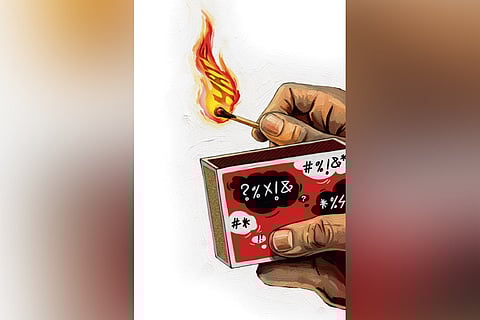

Karnataka’s joint legislature in December passed the country’s first standalone hate speech legislation that is decidedly more stringent than provisions of an omnibus Central law. However, the drafting of the Karnataka Hate Speech and Hate Crimes (Prevention) Bill, 2025, drew sharp criticism from experts and a section of the political class over vague phrases and disproportionately harsh penal provisions. It is now pending before Governor Thawar Chand Gehlot for assent.
The trigger for the bill came from a surge in hate speeches inciting violence over the past three years, especially in the communally sensitive coastal Karnataka region from Mangaluru to Karwar comprising of Udupi, Kundapura, Byndoor and Bhatkal. The killing of a Hindu activist Suhas Shetty, with criminal antecedent, in Mangaluru, in May 2025 by a gang as revenge for his alleged key role in the murder of Mohammed Fazil in July 2022 became the flashpoint.
State home minister Dr G Parameshwara defended the bill saying although the Bharatiya Nyaya Samhita, 2023, has sections against hate speech and crime, they were not harsh enough. He said the Supreme Court too had opined that such criminal offences be dealt with an iron hand as they contribute to disharmony in society. However, the BJP termed it ‘draconian’, charging the government with wanting to create a “police state”. It said the bill curtails the freedom of expression, a fundamental right, and gives the law enforcement force the licence to oppress political adversaries.
Some experts saw merit in the bill saying it would curb forces 'causing social disharmony' and spreading 'ill-will'. It is also being appreciated for its victim-centric approach as the bill mandates compensation for vulnerable 'communities'. But others argue that since the phrases, 'disharmony' and 'ill-will', are subjective, their interpretation would lie with the law enforcement authorities who inevitably confirm to the ruling dispensation’s line. They also raised concerns that if the bill becomes law, it would overlap with the Centre's Bharatiya Nagrik Suraksha Sanhita, 2023 (BNSS), and by misused by the authorities. Issues of disproportionate punishment and overcriminalisation were also voiced.
State vs Central law
"The intent of the bill – to give the state powers to check hate speech – is necessary and valid. The Constitution does not recognise hate speech as free speech. However, the real problem with the bill is the approach it takes to address the problem. It prefers to use the existing police machinery to address the matter. Police in Karnataka, like their counterparts in other states, are not really independent when it comes to questions of what is crime and what is not. Since they take their cue from the political executive, a broad law like this will only give more opportunities to the police to misuse the law, observes Alok Prasanna Kumar, advocate and co-founder of Vidhi Centre for Legal Policy.
"This is not about hate crime prevention so much; it is a hate crime punishment bill. There's an assumption that punishment will lead to prevention but that is simply not true. Criminal law does not create any sort of deterrence unless it is backed by a near perfect enforcement of the law. When law enforcement becomes selective, delayed and arbitrary, the words of a law cease to have any meaning. This bill adds more words with little effect,” Kumar opined.
There is a constitutional dimension to the bill, too, he added. "The Bharatiya Nyaya Samhita already has provisions to deal with hate speech (Section 196) and the BNSS has specific provisions which detail how such an offence will be investigated, tried and punished. The hate crime bill is effectively trying to amend the BNS and BNSS without actually doing so. Though worded differently, the essence of the offence in the bill and the BNS are the same. This creates a situation where the Union law and state law are in conflict with each other. In such a situation, clause (2) of Article 254 of the Constitution comes into play and the state’s law gives way to the Union law, unless the President gives approval to the state law. Simply saying application of other laws is not barred does not address this issue because when two laws are in conflict and cannot be complied with, Article 254 comes into play," he explained.
The bill
The proposed legislation aims to curb and prevent dissemination, publication or promotion of hate speech and crimes that cause disharmony and hatred in the society against individuals or organizations. It provides punishment and adequate compensation to the injured victims. 'Hate speech' includes any expression which is made, published, or circulated, in words either spoken or written or by signs or by visible representations or through electronic communication or otherwise, in public view, with an intention to cause injury, disharmony or feelings of enmity or hatred or ill-will against a person alive or dead, class or group of persons or community, to meet any prejudicial interest.
Defining prejudicial interest
Bias on the grounds of religion, race, caste/community, sex, gender, sexual orientation, place of birth, residence, language, disability, or tribe.
Communication of hate speech, by making, publishing or circulating or any act of promoting, propagating, inciting or abetting or attempting, such hate speech, to cause disharmony or feelings of enmity or hatred or ill-will against any person dead or alive or group of persons or organisation.
'Communication of expression, made in public view, by way of verbal, print, publication, electronic means, or other means to convey such expression.
The words and expressions used and not defined in the Karnataka Act but defined in the BNS or BNSS or the Information Technology Act, 2000 shall have meaning respectively assigned to them in those Act.
Punishment
Imprisonment for not be less than one year, but may extend to seven years with a fine of Rs 50,000. For any subsequent or repetitive offences the punishment shall not be less than two years which may extend to 10 years with fine of Rs 1 lakh. The court may award adequate compensation to the victim by calculating the injury caused due to hate crime, depending upon the gravity of the crime.
The offences under Karnataka Hate Speech and Hate Crimes (Prevention) Bill, 2025, are cognisable, non-bailable and open to trial by a First Class Judicial Magistrate.
Exemption
The provisions of the Act shall not extend to any book, pamphlet, paper, writing, drawing, painting representation or figure in electronic form or otherwise the publication of which is proved to be justified as being for the public good on the ground that it is in the interest of science, literature, art or learning or other objects of general concern; or which is kept or used for bona fide heritage or religious purpose.
Preventive action
The Executive Magistrate or Special Executive Magistrate or any police officer not below the rank of a Deputy Superintendent of Police may take necessary preventive action to maintain peace, good behaviour public order and tranquility on receiving information — or has reason to believe — that a person or a group of persons within the local limits of his jurisdiction is likely to commit an offence or has threatened to commit any offence under the Act, and is of the opinion that there is sufficient ground for proceeding against them.
If the person committing an offence under this Act is an organisation or institution (including unregistered), every person who is in-charge at the time of the offence shall be deemed to be guilty of it and liable to be proceeded against and punished accordingly.
Insulates public servants
The designated officer shall have the power to direct any service provider, intermediary, person or entity to block or remove hate crime materials from its domain, including electronic media. No suit, prosecution or other legal proceedings against public servants for anything done in good faith or intended to be done under the Act.
Political sparring match
"Only those who make provocative speeches oppose the hate speech prevention bill. The law applies to all parties. Why are only the BJP members opposing it? Will hate speech bring peace to the society? The law is being implemented to maintain peace and brotherhood in the society. Hate speech has been increasing in recent days. We have taken steps to control it. The reason why BJP is strongly opposing the bill is because they make hate speeches," Chief Minister Siddaramaiah said.
But BJP leader and former deputy chief minister R Ashoka, Leader of Opposition in Karnataka Legislative Assembly, said: "The bill is not about reform, it is about fear and control. The Congress government is attempting to institutionalise an Emergency-like mindset by criminalising dissent and curbing free expression. Any law that gives sweeping powers to the executive, weakens safeguards, and intimidates citizens is fundamentally anti-democratic. Karnataka has a proud legacy of constitutional governance, not authoritarian experiments. This bill reflects the insecurity of a government that cannot tolerate criticism or accountability. The BJP will oppose every attempt to misuse legislation to silence the voices and undermine democratic freedoms.”
In his pushback, Karnataka law minister H K Patil said: "The purpose of this bill is not to curtail or suppress freedom of expression in any way. It is not possible to suppress a right that has come by the Constitution. If there is a difference of opinion on what qualifies as hate speech, then courts are there to deal with it."
Karnataka High Court advocate Shivaraj B Nanjhappa, said: "The Karnataka government's move could be seen in the prism of minister Priyank Kharge insisting on Siddaramaiah imposing a ban on the activities of the RSS, a non-registered organisation, on using public premises. It is a step towards curbing polarisation and Hindutva-driven nation-building attempts by the RSS and BJP. The bill is seen as a tool to address this, despite criticism that it targets pro-Hindutva elements."