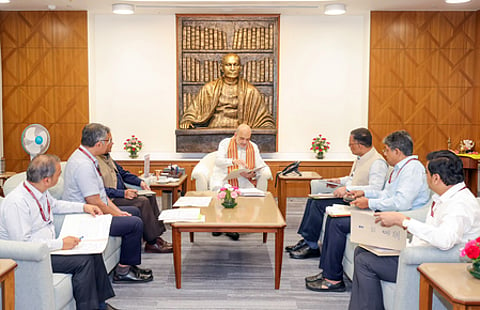

The Centre's high-level committee on demographic changes, chaired by former Supreme Court judge Justice (Retired) Prakash Prabhakar Naolekar, has entered a crucial phase of its work by preparing a detailed questionnaire for States and Union Territories (UTs). The questionnaire, now being shared with State and UT governments, will guide consultations on changing demographic patterns across the country, particularly in border regions, and their implications for governance, development and national security. Alongside demographic data, the panel is seeking State-level feedback to help frame its policy recommendations.
Why has the committee been constituted?
Population dynamics are constantly evolving because of several factors, including fertility rates, migration, urbanisation, economic opportunities, ageing and alleged illegal infiltration. While most of these are a natural feature of every society, their pace and nature vary significantly across different parts of India.
Several States have witnessed declining fertility rates and ageing populations, while others continue to record relatively higher population growth. Internal migration has altered the demographic profile of many urban centres, while international migration and illegal cross-border movement have remained concerns in certain States and UTs with international borders.
The committee has been tasked with comprehensively studying these demographic shifts and recommending measures to help governments anticipate and respond to future challenges. Special emphasis has been placed on border areas, where demographic changes can have implications not only for development planning but also for border management and internal security.
What is the committee asking States and UTs?
The questionnaire covers a broad range of issues. While responses will vary according to the circumstances of each State or UT, the questions broadly seek to understand the practical implications of demographic changes rather than merely documenting population figures.
Among the key issues on which States have been asked to provide inputs are:
What are the effects of demographic changes on public services, infrastructure and security?
What are the instances and impact of illegal immigration, wherever applicable?
What measures have States already taken to address demographic changes?
What policy, legislative and administrative interventions, if any, should be considered at the national level?
Why are these questions important?
Each theme identified in the questionnaire has direct implications for public policy.
Impact on public services
Population changes inevitably influence the demand for government services. Areas experiencing rapid population growth may require additional schools, hospitals, housing, sanitation facilities and welfare infrastructure.
Conversely, districts witnessing population decline or ageing may face a different set of challenges, including higher healthcare requirements for elderly citizens, changing labour markets and underutilised educational infrastructure.
Infrastructure planning
Infrastructure investments typically have a lifespan extending over several decades. Roads, public transport systems, drinking water projects, electricity networks and urban planning all depend on accurate estimates of future population trends.
If demographic shifts are not adequately factored into planning, governments risk creating infrastructure deficits in fast-growing areas while overinvesting in regions with stagnant or declining populations. The exercise is therefore expected to help align future infrastructure development with evolving demographic realities.
Security implications
One of the key themes in the questionnaire relates to security, particularly in border regions. Demographic changes in strategically sensitive areas can influence policing requirements, border management, identity verification systems and local administrative capacity. The committee appears to be examining whether changing population patterns have created new governance challenges that require coordinated responses between the Centre and States.
Illegal immigration
The questionnaire also seeks information on instances and the impact of illegal immigration. Certain border States have, over the years, raised concerns about undocumented cross-border migration and its possible impact on public services, land use, electoral rolls, employment opportunities and security. By seeking structured feedback from States, the committee is attempting to distinguish between local administrative experience and broader national trends. Such information could help formulate evidence-based recommendations on border management, documentation systems and inter-agency coordination.
Measures already taken by States
The questionnaire seeks information on measures that States have already undertaken to address demographic changes. These could include improvements in civil registration systems, migration monitoring, urban planning initiatives, welfare targeting, border surveillance, digital governance mechanisms or local administrative reforms. Documenting these experiences allows the committee to identify best practices that may be replicated elsewhere.
Suggestions for future policy
Suggestions are being sought from States on future policy, legislative, and administrative measures. Instead of adopting a purely top-down approach, the committee is inviting States to recommend reforms based on their administrative experience. These suggestions could cover areas such as population databases, migration management, interdepartmental coordination, urban planning frameworks, social welfare delivery, border administration, and institutional capacity-building. The final recommendations are therefore expected to reflect both national priorities and local perspectives.
How will the consultation process work?
The committee is following a consultative approach. The questionnaire serves as the starting point for structured interactions with State and UT governments. Once written responses are received, the committee is expected to hold discussions with officials to better understand regional concerns and clarify issues wherever required. The consultations may also enable States to highlight demographic challenges that may not be fully captured through statistical datasets alone.
For example, a border district facing seasonal migration, a metropolitan city experiencing rapid urban expansion or a remote region dealing with population decline may each require different policy responses. The consultation process is therefore intended to generate qualitative inputs alongside quantitative evidence.
The committee will also rely on demographic data, administrative records, research studies and inputs from relevant ministries and agencies before finalising its recommendations.
How could the findings influence policymaking?
Officials say the recommendations could shape policymaking across multiple sectors. One, help improve long-term planning by enabling governments to incorporate demographic projections into budgeting and infrastructure development. Two, contribute to better targetting of welfare schemes by identifying areas where population growth or migration has significantly altered service requirements. Three, lead to future administrative reforms relating to migration management, identity documentation, urban governance and coordination between the Centre and States.
Why is the timing significant?
Apart from the primary objectives, governments increasingly require granular population data to support decisions on healthcare, education, employment, transport, housing and social welfare. The study is therefore intended to assess these evolving demographic trends and identify areas requiring policy attention.
What is the larger picture?
By seeking detailed inputs from States and UTs on public services, infrastructure, security, migration and administrative responses, the panel hopes to build a clearer picture of India's evolving demographic landscape. Its recommendations could influence future planning across sectors ranging from urban development and social welfare to border management and public administration.
