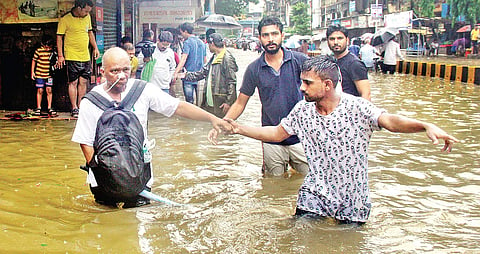

Images of Gurugram and Mumbai submerged in floodwaters after heavy downpours and Bengaluru reeling under flash floods now arrive with a strange, uncanny familiarity. Every monsoon, cars drift through submerged streets, airports shut down, office campuses become islands, and commuters remain immured in vehicles for hours.
Authorities routinely describe each episode as exceptional, invoking record rainfall, unprecedented precipitation or once-in-a-century storms. Yet these ostensibly singular catastrophes recur with almost-obvious regularity. What was once disparaged as a seasonal monsoon nuisance has become an acknowledged urban disaster, wrecking infrastructure, displacing populations and inflicting economic wrack worth thousands of crores.
If cities have long known their vulnerabilities, why do they continue to flood? Rainfall may initiate the event, but the dominant model of urban development systematically converts precipitation into a human-made catastrophe. The crisis is not natural. It is engineered.
Is heavy rainfall alone responsible for urban flooding?
No. Rainfall may trigger flooding, but the scale of urban inundation is largely determined by how cities are planned and built. The dominant model of urban development systematically converts precipitation into disaster by steadily reducing the landscape's ability to absorb water.
What kind of flooding affects Indian cities most?
The dominant crisis is pluvial flooding — a localised, rainfall-driven event where surface runoff overwhelms urban terrain and drainage networks without rivers overflowing or coastal storm surges.
Unlike fluvial flooding, which is shaped by regional hydrology and climatic vagaries, pluvial flooding is directly produced by local land-use decisions and the aggressive transformation of natural topography into impermeable concrete.
How have Indian cities become more vulnerable to flooding?
Historically, Indian cities evolved alongside interconnected networks of tanks, wetlands, marshes and floodplains. This natural infrastructure functioned as a cavernous sponge, temporarily absorbing peak monsoon volumes, ameliorating rapid runoff and gradually replenishing groundwater.
Rapid, uncontrolled urban sprawl has systematically forced these ecosystems toward what researchers describe as a forced death, erasing living hydrological systems in the service of real estate extraction.
What does the evidence show?
The pattern is strikingly similar across cities.
Bengaluru recorded a 632% increase in built-up area alongside a 79% decline in water bodies between 1973 and 2010. Chennai's Pallikaranai marshland had shrunk to just 12% of its original extent by 2011. Mumbai's reclamation of coastal wetlands and mangroves has drastically reduced tidal drainage capacity. Hyderabad's encroachment on lakes and natural nalas has produced recurring waterlogging, while Kolkata's wetlands and historic canal networks have been diminished by real estate pressure.
In each case, the ramifications of ecological erasure are identical: water that once percolated slowly through living soil now accelerates across paved surfaces, generating immense peak runoff that ageing, choked drainage infrastructure cannot absorb.
Why do drainage systems fail so easily?
Most municipal stormwater systems are archaic colonial-era relics designed for a fraction of today's populations and far lower baseline runoff rates.
Years of under-maintenance, heavy siltation and the routine dumping of solid waste and construction debris leave these ageing arteries prone to immediate blockages when heavy rains descend. Anthropogenic climate change is intensifying these faultlines further.
Who bears the burden when cities flood?
Floodwater may appear socially indiscriminate, but its consequences are deeply iniquitous.
Marginalised communities living in informal settlements are often compelled to occupy low-lying land, drainage margins and floodplains after being excluded from formal real estate markets. Repeated inundation destroys hard-earned assets, compromises fragile housing and immures families in predatory debt cycles.
Recovery in informal settlements stands in stark contrast to the relatively swift restoration of services in wealthier urban enclaves. Urban flooding remains a perfect reflection of the existing structural inequalities on muddy water.
Why does governance continue to dither?
The persistence of urban flooding is rarely a failure of engineering knowledge. It is a crisis of governance and political rectitude.
Responsibility for urban waterscapes is fractured across municipal corporations, development authorities, water boards, public works departments and disaster management agencies. Operating in institutional silos, drainage upgrades are planned independently of land-use blueprints, while environmental conservation remains disconnected from infrastructure development.
How do spending priorities make matters worse?
Municipal spending continues to favour highly visible, politically rewarding projects such as flyovers, metros and expressways over the invisible work of maintaining stormwater systems.
As a result, cities often desilt drains only after floods rather than before the monsoon.
Does poor data hamper flood preparedness?
Yes. Many municipalities still lack accurate neighbourhood-scale flood-risk maps, localised rainfall records and digitised drainage inventories. Without proper record-keeping, planners cannot adequately model urban runoff or anticipate future vulnerabilities. Climate resilience therefore remains immured within underfunded environmental departments instead of being integrated into master plans, zoning laws and broader urban development.
Are there examples of better urban governance?
Yes. After catastrophic flooding, Surat established the Surat Climate Change Trust, bringing together government agencies, businesses and researchers to coordinate real-time early warning systems and resilience planning.
Ahmedabad's Heat Action Plan, although designed for extreme heat rather than flooding, demonstrated that coordinated governance and cross-agency communication can substantially reduce disaster-related mortality by overcoming institutional fragmentation.
Can cities rely only on bigger drains and concrete infrastructure?
No. For decades, flood control relied primarily on structural grey engineering through larger drains, embankments, pumps and massive infrastructure projects. While these remain necessary, they are no longer sufficient.
Modern urban planning increasingly embraces Ecosystem-Based Adaptation by integrating natural ecosystems into urban infrastructure. Instead of treating rainwater as an adversary to be funneled through concrete conduits, it promotes sponge cities using permeable pavements, urban green spaces and protected wetlands to absorb, filter and gradually release water.
What does a sponge city look like in practice?
The East Kolkata Wetlands offer perhaps the most pellucid example. The internationally recognised wetland system functions simultaneously as Kolkata's natural kidney and flood buffer. It naturally treats a substantial share of the city's sewage before the nutrient-rich water supports fish farming and vegetable cultivation. Livelihood stability and flood mitigation thus coalesce in a single living system at negligible cost compared with the billions spent on grey infrastructure elsewhere.
What choice lies ahead for India's cities?
As India's cities prepare to accommodate hundreds of millions of additional residents, the challenge transcends drainage calculations or sea-wall specifications.
Will lakes, marshes and floodplains continue to be viewed as desiccated wastelands awaiting conversion into concrete? Or will urban governance finally learn to accommodate water as a permanent, living element of the urban landscape—not an adversary to be vanquished, but a force to be respected?
The answer will determine whether India's cities survive the climate century ahead, or continue to drown in the consequences of their own turpitude.
