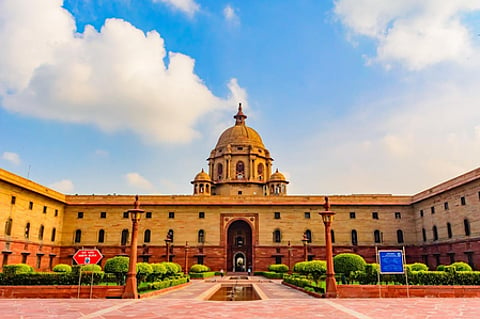

India is set to get a major cultural institution in the heart of New Delhi, Yuge Yugeen Bharat Museum, bringing together its heritage spanning more than 5,000 years. With an estimated cost of Rs 3,230 crore, the project aims to preserve and showcase India's art, architecture, knowledge systems, traditions and cultural practices for future generations.
It will house rare objects from the National Museum and collections from across the country, using modern technology to make exhibitions more interactive. Its first gallery, titled “Adornments”, is expected to open in the second half of 2027.
What is the Yuge Yugeen Bharat Museum and what is its purpose?
Yuge Yugeen Bharat, meaning “Timeless Eternal India”, is conceived as a national cultural institution that will present India's civilisational journey through its tangible and intangible heritage. Tangible heritage includes physical objects such as sculptures, paintings, jewellery and architectural remains, while intangible heritage covers traditions, knowledge and cultural practices passed down through generations.
The “museum of history” will bring together the country's diverse cultural legacy in a single institution, highlighting the continuity and diversity of India’s civilisation.
When was the project announced and what steps have been taken since then?
Prime Minister Narendra Modi first announced the project in May 2023. He also inaugurated a virtual walkthrough of the proposed institution, allowing people to get a digital preview of the planned development.
In December 2024, the Government signed a memorandum of understanding with France Museums Développement (FMD) to conduct a feasibility study and prepare a preliminary master plan for adapting the North and South Blocks.
The Public Investment Board (PIB) appraised the proposal on 27 July 2026. The PIB is a high-level appraisal body under the Department of Expenditure in the Ministry of Finance. It examines capital investment proposals from central ministries, departments and public sector undertakings. The Ministry of Culture, which is executing the project, has agreed with its recommendations.
The Cabinet Committee on Economic Affairs subsequently approved the development at an estimated cost of Rs 3,230 crore.
Why were the North and South Blocks selected?
Designed by British architect Herbert Baker, the two buildings on Raisina Hill have been central to India's government administration for more than nine decades.
The South Block housed the Prime Minister's Office (PMO) after Independence. Cabinet meetings involving 16 prime ministers were held in these buildings. The North Block accommodated several key ministries, including Home Affairs, External Affairs, Finance, and Petroleum and Natural Gas.
The PMO and the ministries have since moved to newly constructed offices under the Central Vista Redevelopment plan. The PMO has shifted to Seva Teerth, while the ministries have moved to the Kartavya Bhavans. The vacated Secretariat buildings are now being repurposed for their new cultural role.
How will the two historic buildings be adapted for their new role?
The North and South Blocks together cover 1.17 lakh square metres, including the basements, ground floors and two upper floors. They have 950 rooms in total, which will be adapted for exhibitions and other visitor facilities.
The conversion will follow the principle of minimal intervention, meaning that only necessary changes will be made to accommodate the new use. The buildings' historic character, façades and architectural integrity will be preserved. Existing rooms, corridors and courtyards will be converted into galleries and exhibition areas.
The Ministry of Housing and Urban Affairs (MoHUA) is undertaking the conservation and preservation of the buildings. The Ministry of Culture is developing the museum's storyline, deciding the gallery themes and selecting the exhibits.
What expertise did France Museums Développement bring to the project?
The Government signed an MoU with France Museums Développement in December 2024 to help plan the adaptive reuse of the North and South Blocks, ensuring that their historic character could be retained while accommodating their new purpose.
The French agency has experience in transforming historic buildings into major cultural institutions. Its work includes the Louvre Palace, which houses the world's largest and most visited museum, as well as the Grand Palais and Hôtel de la Marine.
How large will the exhibition space be and what facilities will visitors have?
The Museum is expected to rank among the world's largest cultural institutions by exhibition space. Its display area will exceed that of three renowned museums:
Louvre Museum, Paris: 73,000 square metres.
British Museum, London: 70,000 square metres.
Hermitage Museum, St Petersburg, Russia: 66,800 square metres.
The project is being designed to handle an annual footfall of up to one crore visitors. Proposed visitor facilities include children's zones, food courts, souvenir shops, performance spaces and accessible public areas.
What subjects will the 30 galleries cover?
The 30 galleries will explore different aspects of India's civilisational history. Their proposed themes include Architecture and Cityscapes, Mathematics and Astronomy, Languages and Scripts, Faith and Spirituality, and Bharat Connects – Trade and Ideas.
The exhibitions will combine objects from different periods and regions to show how India's cultural traditions have developed and interacted over time. Indoor and outdoor immersive spaces, including courtyards, will form part of the exhibition design.
The galleries are being planned around interconnected themes rather than isolated historical periods. Carefully selected collections, narratives and immersive experiences will highlight India's plurality and the continuity of its cultural traditions.
Where will the exhibits come from and how many objects have been identified?
Approximately 18 lakh objects have been identified for possible display. The collections are being brought together from institutions and private holdings across the country.
The sources include:
The National Museum in New Delhi.
Other museums under the Ministry of Culture.
52 Archaeological Survey of India (ASI) site museums.
Various state museums.
Private collections.
The process of studying the collections and deciding how individual objects will be incorporated into the exhibitions is still underway.
Which significant historical objects are proposed for display?
The collections being considered include objects representing different periods of Indian history. Some notable examples are:
Indus Valley Terracotta Hourglass: 2500–1750 BCE.
Maurya Edict Pillar Fragment: 3rd century BCE.
Gupta-period Surya Sculpture: 5th century CE.
Chola-period Nataraja Bronze: 10th–11th century CE.
Konark Sun Wheel: 13th century CE.
What will the first gallery, 'Adornments', display?
The first gallery, titled “Adornments”, is expected to open to the public in the North Block in the second half of 2027.
It will showcase a large collection of rare, ancient gems and jewellery, alongside miniature paintings and other artworks. Proposed exhibits include Taxila ornaments dating from the 4th century BCE to the 1st century CE, the jewels of the Nizams of Hyderabad, and important Gandhara art pieces from the Kushana period (2nd–3rd century CE).
How will technology be used in the exhibitions?
The project plans to incorporate Augmented Reality (AR), Virtual Reality (VR) and Artificial Intelligence (AI) to support interactive interpretation and storytelling.
These technologies will help present information about historical objects and their backgrounds in more engaging and accessible ways.
Earlier this month, the Ministry of Culture collaborated with Google Arts & Culture on digitisation work related to historic buildings and collections. This involves creating digital records of the buildings and objects to support their documentation and presentation.
Who will benefit from the institution's educational and cultural activities?
The institution will cater to the general public, students, researchers, scholars, cultural practitioners and domestic and international tourists.
It is intended to provide opportunities for learning, research, cultural engagement and appreciation of India's heritage. Researchers and scholars will have access to a wide range of collections. Cultural practitioners will also have opportunities for engagement through the institution's activities and facilities.
What employment opportunities is the project expected to create?
It will create opportunities for artisans, craftspeople, researchers, museologists, designers, performers and other creative professionals. It is also expected to support livelihoods in the hospitality and tourism sectors.
How will the project support Indian artisans and manufacturers?
In line with the government's Make in India initiative, the project will encourage domestic manufacturing of world-class museum materials and products through structured vendor development (helping businesses become suppliers).
How will the museum generate revenue?
The institution is expected to earn recurring revenue through several activities and visitor services. These include ticket sales, food and beverage facilities, events, venue rentals, digital experiences, guided tours, retail outlets and other visitor services.
When will the project be completed?
The development will take place in phases, with galleries and exhibitions introduced in stages.
The first gallery, “Adornments”, is expected to open in the North Block in the second half of 2027. The entire project is targeted for completion by March 2031.
