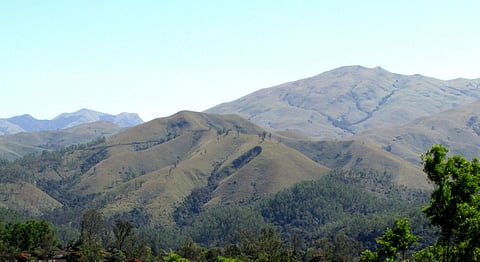

As the time for filing claims and objections and listing suggestions on the 7th draft notification for the implementation of the Kasturirangan Report draws to an end, debate over its implementation has gained centre-stage. The draft notification to protect the fragile and ecologically sensitive Western Ghats has raised concerns. Each of the six states — Gujarat, Maharashtra, Goa, Karnataka, Keralam and Tamil Nadu — has been handling the issue differently.
While Keralam and Tamil Nadu are undertaking independent studies on ecologically sensitive areas, Karnataka has sought a year’s time to undertake a field study. In the meantime, experts are looking at the Supreme Court and the National Green Tribunal for stringent action.
Against this backdrop, we attempt to examine the productive as well as critical appraisal that the Report has received over the past 12 years.
What is the Kasturirangan report and the 7th draft notification?
To protect the UNESCO-declared World Heritage Site and biodiversity hotspot — the Western Ghats’ ecologically sensitive areas (ESA) — the Ministry of Environment, Forest and Climate Change (MoEFCC) announced an environmental blueprint in 2013. It constituted a High Level Working Group (HLWG) under the chairmanship of former Indian Space Research Organisation (ISRO) Chairman K Kasturirangan.
After conducting a survey based on satellite imagery data, the committee proposed declaring around 37% of the Western Ghats as ESA in the six states through which the Western Ghats run.
The Kasturirangan report was shared with all six states, seeking objections and suggestions. This was done after the states rejected the report on the Western Ghats by noted ecologist and founder of the Centre for Ecological Sciences, Madhav Gadgil, published in 2011.
For the implementation of the Kasturirangan report, the HLWG listed 59,940 sq km of landscape and a continuous band of natural vegetation extending over a horizontal distance of 1,500 km as ecologically sensitive.
The first draft notification seeking the opinions of the six state governments was issued on March 10, 2014. It was issued after multiple meetings and correspondence with the state governments since the formation of the HLWG. Six drafts were issued over the years. Each draft was revised based on the opinions and suggestions obtained from the state governments regarding modifications to the ESA boundaries. The HLWG also held a series of meetings from 2022 to 2024 to address the issues raised by the states concerning discrepancies or information gaps in the published drafts.
The 7th draft notification was issued on July 27, 2026, by the MoEFCC, giving the states and citizens 60 days to file their objections. This was issued on the directions of the Supreme Court and the National Green Tribunal, which are hearing cases pertaining to the protection of the Western Ghats. The deadline for submitting objections by the respective states ended on September 27, 2026.
Why was a special panel formed and given an additional year’s extension to complete the exercise?
To undertake dedicated field studies of the proposed ESA areas listed by the HLWG in all six Western Ghats states, the MoEFCC created a special expert panel headed by former Director General of Forests Sanjay Kumar in 2022. This team visited all the states and noted the opinions of officials, experts, citizens and other stakeholders. However, the teams were unable to compile and submit a report due to a lack of cooperation and pushback from the state governments. The panel was therefore given a year’s extension until July 2027 to submit its final report.
Experts, however, have expressed concern about whether this extended deadline will be met. This concern arises particularly after the Karnataka state government passed a resolution in the special assembly session on September 22, 2026, unanimously opposing the 7th draft notification for the implementation of the Kasturirangan report. The Karnataka government sought a year’s time to undertake a field survey to prepare a fresh list of regions to be included in the ESA.
How much area in each state was listed for the ESA in the 7th draft notification?
As per the draft notification, the total ESA area listed was 56,825.7 sq km. Of this, the highest area under ESA was listed in Karnataka, as Karnataka houses the highest part of the Western Ghats (20,668 sq km), followed by Maharashtra (17,340 sq km), Kerala (9,993.7 sq km), Tamil Nadu (6,914 sq km), Goa (1,461 sq km) and Gujarat (449 sq km).
What are the contentions of the state governments?
The states have been objecting to the implementation of the Kasturirangan report, arguing that no field survey was undertaken while preparing the draft and that only satellite imagery data was used. They also said emphasis was being laid on conservation rather than looking at the holistic and inclusive development of the region and its locals.
The states stressed that satellite data does not distinguish between forest land, estates, agricultural lands and other green pastures. The village boundaries are not clearly demarcated from forest boundaries, and the ground reality of developmental activities has not been accounted for.
They also contended that the opinions of stakeholders — particularly villagers — were not included while framing the draft.
The states also contended that the draft includes no provision to provide financial compensation or alternative sources of livelihood to forest dwellers and locals who will be displaced when the final notification is issued. The HLWG, however, stated that there will be no displacement or dislocation of local people living in habitations within the demarcated ESA in the Western Ghats and practising agriculture and plantation activity.
Does this expose decade-long Centre-state deadlocks?
Experts admit that the repeated issuance of drafts and extensions of time to finalise or reject the entire report, as happened with the Gadgil report, exposes the long-running tussle between the state governments and the Centre. Experts say the Tamil Nadu and Kerala governments sought time from the Centre during earlier drafts and subsequently started the exercise of conducting field surveys and demarcating land to be declared as ESA. But this has not been effectively done in Karnataka, where foot-dragging and seeking a year’s time for a field survey will further delay the implementation of the Kasturirangan report, particularly when Karnataka goes to polls in 2028.
The 7th draft makes a special mention of Kerala, which undertook the exercise of demarcating its ESA through physical verification. Kerala recommended the inclusion of 9,993.7 sq km as ESA, which included 9,107 sq km of forest area and 886.7 sq km of non-forest area. This was instead of the 13,108 sq km suggested by the HLWG.
Explaining the consequence of the tussle and citing Karnataka as an example, experts say the state has been the lone defaulter for not completing the field exercise since 2014. This long delay will give the MoEFCC grounds to inform the Supreme Court and the NGT of the consistent defaulting by the Karnataka government. Under such a situation, the apex court and the NGT could reprimand the Karnataka government and direct the MoEFCC to implement the suggested draft for Karnataka while including the suggestions listed by the remaining five states when implementing the Kasturirangan report. Or, the court and tribunal can grant an extension based on the Karnataka government’s request, but with a stringent timeline for compliance.
Karnataka, one of the last states to act on the report, submitted its objections after the cabinet meeting on September 22. The Centre is yet to respond. The latter is optimistic that after dragging its feet for 13 years, the Centre will agree to its demand for a year’s time to conduct a field survey and submit its final list of areas and villages to be included in the ESA category.
How should ecology and economy be balanced for the survival of local communities, including the concerns of quarrying and tourism?
The states have been opposing the implementation of the Kasturirangan report because it suggests phasing out mining and quarrying activities in the ESA areas and all existing mines within five years from the date of issuing the final ESA notification or the expiry of the existing mining lease. The draft also states that no new thermal power projects or expansions of existing thermal power plants should be allowed in ESAs. The draft also bans the operation of red category (polluting) industries and restricts development projects, townships and construction activities above 20,000 square metres.
The states contended that this will affect the economic prospects of locals and the state as a whole.
The states have suggested a revision based on ground reality and the growing economy, keeping in mind the need to protect forest patches and manage man-animal conflict. While they suggested imposing restrictions on mining and quarrying, they objected to their closure. Governments and stakeholders have suggested relooking at the restrictions imposed on developmental activities to allow for inclusive growth.
They also sought to promote ecological activities, including undertaking eco-tourism activities around forest areas to support people’s livelihoods. Governments have stated that tourism not only helps draw people to forests but also creates livelihood opportunities in multiple sectors. It helps in the holistic growth of the region and in the gradual shift in means of livelihood among people, while also addressing the concern of displacement.
